


 Cart
Cart
 sales@molnova.com



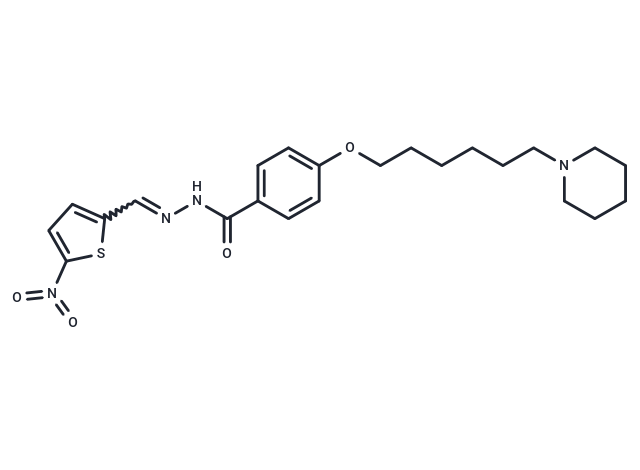
TGFβ1-IN-2
CAS No. 2700263-58-5
TGFβ1-IN-2( —— )
Catalog No. M36620 CAS No. 2700263-58-5
TGFβ1-IN-2, a derivative of diarylacylhydrazones, effectively inhibits fibroblast activation and proliferation and holds potential for idiopathic pulmonary fibrosis (IPF) research .
Purity : >98% (HPLC)
 COA
Datasheet
HNMR
HPLC
MSDS
Handing Instructions
COA
Datasheet
HNMR
HPLC
MSDS
Handing Instructions
| Size | Price / USD | Stock | Quantity |
| 5MG | 387 | In Stock |


|
| 10MG | 471 | In Stock |
|
| 25MG | 630 | In Stock |
|
| 50MG | 768 | In Stock |
|
| 100MG | 977 | In Stock |
|
| 200MG | 1283 | In Stock |
|
| 500MG | Get Quote | In Stock |
|
| 1G | Get Quote | In Stock |
|
Biological Information
-
Product NameTGFβ1-IN-2
-
NoteResearch use only, not for human use.
-
Brief DescriptionTGFβ1-IN-2, a derivative of diarylacylhydrazones, effectively inhibits fibroblast activation and proliferation and holds potential for idiopathic pulmonary fibrosis (IPF) research .
-
DescriptionTGFβ1-IN-2, a derivative of diarylacylhydrazones, effectively inhibits fibroblast activation and proliferation and holds potential for idiopathic pulmonary fibrosis (IPF) research .
-
In Vitro——
-
In Vivo——
-
Synonyms——
-
PathwayOthers
-
TargetOther Targets
-
RecptorOthers
-
Research Area——
-
Indication——
Chemical Information
-
CAS Number2700263-58-5
-
Formula Weight458.57
-
Molecular FormulaC23H30N4O4S
-
Purity>98% (HPLC)
-
Solubility——
-
SMILESC(=NNC(=O)C1=CC=C(OCCCCCCN2CCCCC2)C=C1)C=3SC(N(=O)=O)=CC3
-
Chemical Name——
Shipping & Storage Information
-
Storage(-20℃)
-
ShippingWith Ice Pack
-
Stability≥ 2 years
Reference
molnova catalog



related products
-
1-Octacosanol
1-Octacosanol is an active biochemical.
-
Epischisandrone
Epischisandrone is a natural product for research related to life sciences.
-
Eledoisin trifluoroa...
Eledoisin is a peptide extracted from the posterior salivary glands of certain small octopi (Eledone spp., Mollusca), or obtained by synthesis.?Its actions resemble those of SUBSTANCE P;?it is a potent vasodilator and increases capillary permeability.
