


 Cart
Cart
 sales@molnova.com



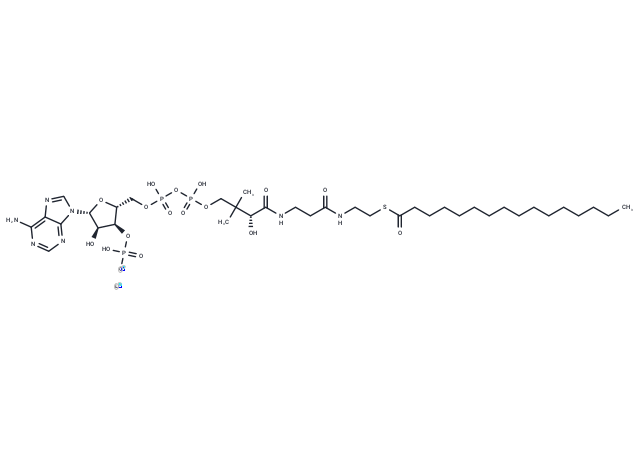
Palmitoyl CoA lithium
CAS No. 188174-64-3
Palmitoyl CoA lithium( —— )
Catalog No. M36579 CAS No. 188174-64-3
Palmitoyl CoA lithium (Palmitoyl coenzyme A lithium) is a major component of fatty acids involved in the carnitine shuttle system, beta-oxidation, and the tricarboxylic acid cycle, and can be used to study metabolic disorders in the body.
Purity : >98% (HPLC)
 COA
Datasheet
HNMR
HPLC
MSDS
Handing Instructions
COA
Datasheet
HNMR
HPLC
MSDS
Handing Instructions
| Size | Price / USD | Stock | Quantity |
| 2MG | 357 | In Stock |


|
| 100MG | Get Quote | In Stock |
|
| 200MG | Get Quote | In Stock |
|
| 500MG | Get Quote | In Stock |
|
| 1G | Get Quote | In Stock |
|
Biological Information
-
Product NamePalmitoyl CoA lithium
-
NoteResearch use only, not for human use.
-
Brief DescriptionPalmitoyl CoA lithium (Palmitoyl coenzyme A lithium) is a major component of fatty acids involved in the carnitine shuttle system, beta-oxidation, and the tricarboxylic acid cycle, and can be used to study metabolic disorders in the body.
-
DescriptionPalmitoyl coenzyme A lithium is an acyl-CoA thioester that can be transported into the mitochondrial matrix via the carnitine shuttle system and is involved in β-oxidation. Palmitoyl coenzyme A lithium can also be used as a substrate for sphingosine biosynthesis.
-
In VitroPalmitoyl coenzyme A lithium (100 μM) reversibly inhibits acetyl coenzyme A carboxylase activity from chicken hepatocytes and is competitive with citric acid and has an important role in the regulation of fatty acid synthesis in vivo.Palmitoyl coenzyme A lithium with a high levels in mitochondria reduces the entry of ADP, which leads to an increased inhibition of glutamate dehydrogenase by palmitoyl CoA.
-
In Vivo——
-
Synonyms——
-
PathwayProteasome/Ubiquitin
-
TargetEndogenous Metabolite
-
RecptorEndogenous Metabolite
-
Research Area——
-
Indication——
Chemical Information
-
CAS Number188174-64-3
-
Formula Weight
-
Molecular FormulaC37H65N7O17P3S.xLi
-
Purity>98% (HPLC)
-
Solubility——
-
SMILESO[C@H]1[C@@H](O[C@@H]([C@H]1OP(O)([O-])=O)COP(OP(OCC(C)(C)[C@@H](O)C(NCCC(NCCSC(CCCCCCCCCCCCCCC)=O)=O)=O)(O)=O)(O)=O)N2C3=NC=NC(N)=C3N=C2.[Li+] xLi
-
Chemical Name——
Shipping & Storage Information
-
Storage(-20℃)
-
ShippingWith Ice Pack
-
Stability≥ 2 years
Reference
1. A G Goodridge, et al. Regulation of the activity of acetyl coenzyme A carboxylase by palmitoyl coenzyme A and citrate. J Biol Chem. 1972 Nov 10;247(21):6946-52.?
molnova catalog



related products
-
5,6-Dihydroxyindole
5,6-Dihydroxyindole (Dopamine lutine) is a melanin precursor and has a broad-spectrum antibacterial, antiviral, antifungal, antiparasitic activity.
-
Methyl 4-anisate
Methyl anisate is an endogenous metabolite.
-
1,2-Dipalmitoyl-sn-g...
1,2-Dipalmitoyl-sn-glycerol 3-phosphate sodium, a phosphatidic acid, is a human endogenous metabolite.
