


 Cart
Cart
 sales@molnova.com



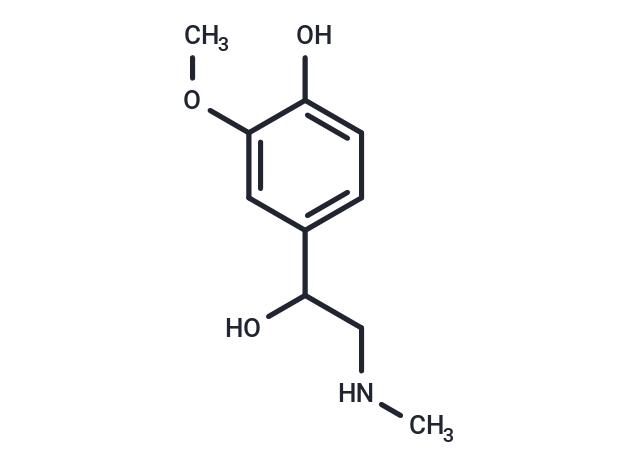
Metanephrine
CAS No. 5001-33-2
Metanephrine( —— )
Catalog No. M36570 CAS No. 5001-33-2
Metanephrine is an o-methylated metabolite of catecholamines and can be used as a marker for different hereditary pheochromocytomas.
Purity : >98% (HPLC)
 COA
Datasheet
HNMR
HPLC
MSDS
Handing Instructions
COA
Datasheet
HNMR
HPLC
MSDS
Handing Instructions
| Size | Price / USD | Stock | Quantity |
| 2MG | 29 | In Stock |


|
| 5MG | 46 | In Stock |
|
| 10MG | 73 | In Stock |
|
| 25MG | 121 | In Stock |
|
| 50MG | 174 | In Stock |
|
| 100MG | 259 | In Stock |
|
| 200MG | Get Quote | In Stock |
|
| 500MG | Get Quote | In Stock |
|
| 1G | Get Quote | In Stock |
|
Biological Information
-
Product NameMetanephrine
-
NoteResearch use only, not for human use.
-
Brief DescriptionMetanephrine is an o-methylated metabolite of catecholamines and can be used as a marker for different hereditary pheochromocytomas.
-
DescriptionMetanephrine is the O-methylated metabolite of epinephrine that can be used for the research of diagnosis of pheochromocytoma.
-
In VitroMetanephrine inhibits MPP+ uptake into Caki-1 cells and rat hepatocytes with IC50s of 34.2 μM and 302.0 μM, respectively.
-
In Vivo——
-
Synonyms——
-
PathwayOthers
-
TargetOther Targets
-
RecptorOthers
-
Research Area——
-
Indication——
Chemical Information
-
CAS Number5001-33-2
-
Formula Weight197.23
-
Molecular FormulaC10H15NO3
-
Purity>98% (HPLC)
-
SolubilityIn Vitro:?DMSO : 125 mg/mL (633.78 mM; Ultrasonic )
-
SMILESOC1=CC=C(C=C1OC)C(O)CNC
-
Chemical Name——
Shipping & Storage Information
-
Storage(-20℃)
-
ShippingWith Ice Pack
-
Stability≥ 2 years
Reference
1. Eisenhofer G, et al. Measurements of plasma methoxytyramine, normetanephrine, and metanephrine as discriminators of different hereditary forms of pheochromocytoma. Clin Chem. 2011 Mar;57(3):411-20.?
molnova catalog



related products
-
Apigenin-7-diglucuro...
Apigenin-7-diglucuronide is a flavonoid glycoside and is present in an assortment of medicinal plants with anti-inflammatory or ant-oxidant activities. Apigenin-7-diglucuronide protects retinas against bright light-induced photoreceptor degeneration through the inhibition of retinal oxidative stress and inflammation.
-
N-Acetyl-β-Asp-Glu
Spaglumic acid is the β-aspartyl isoform of N-Acetyl-l-aspartylglutamate (isospaglumic Acid is N-(N-Acetyl-l-α-aspartyl)-l-glutamic acid).
-
Tamarixetin
Tamarixetin (4'-O-Methyl Quercetin) is a natural flavonoid derivative of quercetin, with anti-oxidative and anti-inflammatory effects. Tamarixetin protects against cardiac hypertrophy.
