


 Cart
Cart
 sales@molnova.com



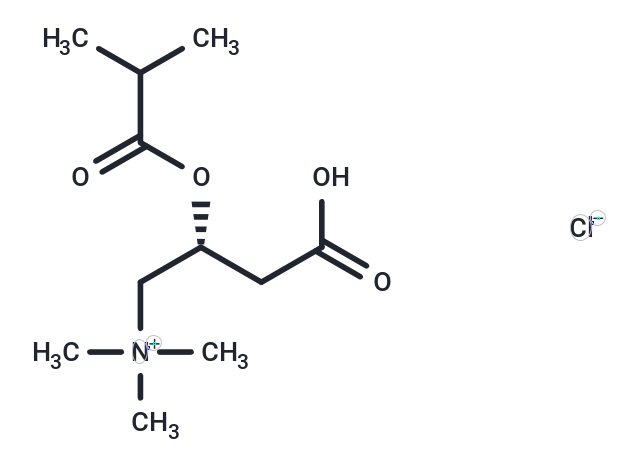
Isobutyryl-L-carnitine chloride
CAS No. 6920-31-6
Isobutyryl-L-carnitine chloride( —— )
Catalog No. M36568 CAS No. 6920-31-6
Isobutyryl-L-carnitine chloride is a potential clinical OCT1 biomarker for DDI evaluation and can be used to study heart failure.
Purity : >98% (HPLC)
 COA
Datasheet
HNMR
HPLC
MSDS
Handing Instructions
COA
Datasheet
HNMR
HPLC
MSDS
Handing Instructions
| Size | Price / USD | Stock | Quantity |
| 1 mL x 10 mM in DMSO | 37 | In Stock |


|
| 5MG | 28 | In Stock |
|
| 10MG | 38 | In Stock |
|
| 100MG | Get Quote | In Stock |
|
| 200MG | Get Quote | In Stock |
|
| 500MG | Get Quote | In Stock |
|
| 1G | Get Quote | In Stock |
|
Biological Information
-
Product NameIsobutyryl-L-carnitine chloride
-
NoteResearch use only, not for human use.
-
Brief DescriptionIsobutyryl-L-carnitine chloride is a potential clinical OCT1 biomarker for DDI evaluation and can be used to study heart failure.
-
DescriptionIsobutyryl-L-carnitine chloride is a product of the acyl-CoA dehydrogenases.
-
In Vitro——
-
In Vivo——
-
Synonyms——
-
PathwayProteasome/Ubiquitin
-
TargetEndogenous Metabolite
-
RecptorEndogenous Metabolite
-
Research Area——
-
Indication——
Chemical Information
-
CAS Number6920-31-6
-
Formula Weight267.75
-
Molecular FormulaC11H22ClNO4
-
Purity>98% (HPLC)
-
SolubilityIn Vitro:?H2O : 250 mg/mL (933.71 mM; Ultrasonic) DMSO : 30 mg/mL (112.04 mM; Ultrasonic )
-
SMILES[C@H](OC(C(C)C)=O)(C[N+](C)(C)C)CC(O)=O.[Cl-]
-
Chemical Name——
Shipping & Storage Information
-
Storage(-20℃)
-
ShippingWith Ice Pack
-
Stability≥ 2 years
Reference
1. Cao C, et, al. Metabonomic analysis of toxic action of long-term low-level exposure to acrylamide in rat serum. Hum Exp Toxicol. 2018 Dec; 37(12): 1282-1292.?
molnova catalog



related products
-
2-(1-methyl-1H-imida...
2-(1-methyl-1H-imidazol-4-yl)acetic acid (2-(1-methylimidazol-4-yl)acetic acid) is a plasma histamine derivative that is a biomarker for identifying lymphangioleiomyomatosis.
-
Pseudouridine
Pseudouridine is the most abundant modified nucleoside in non-coding RNAs. It enhances the function of transfer RNA and ribosomal RNA by stabilizing RNA structure.
-
1-Dodecanol
1-Dodecanol is an endogenous metabolite and a saturated fatty alcohol from coconut oil fatty acids.
