


 Cart
Cart
 sales@molnova.com



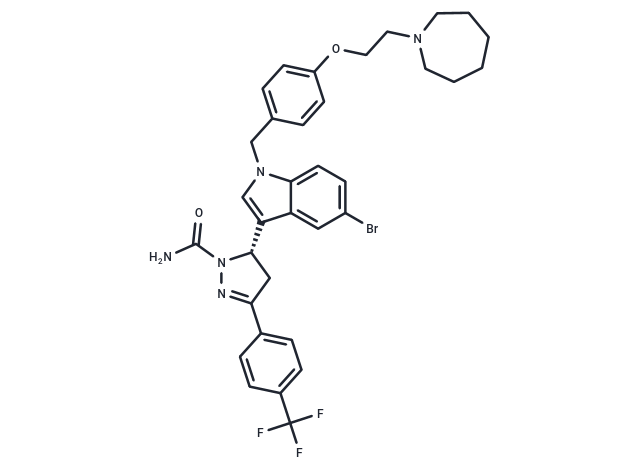
JAK2/STAT3-IN-1
CAS No. 2485758-50-5
JAK2/STAT3-IN-1( —— )
Catalog No. M36471 CAS No. 2485758-50-5
JAK2/STAT3-IN-1 is a GP130 inhibitor with anti-tumor effects and can be used to study inflammation, autoimmunity and cancer.
Purity : >98% (HPLC)
 COA
Datasheet
HNMR
HPLC
MSDS
Handing Instructions
COA
Datasheet
HNMR
HPLC
MSDS
Handing Instructions
| Size | Price / USD | Stock | Quantity |
| 5MG | 686 | In Stock |


|
| 10MG | 938 | In Stock |
|
| 25MG | 1444 | In Stock |
|
| 50MG | 1841 | In Stock |
|
| 100MG | Get Quote | In Stock |
|
| 200MG | Get Quote | In Stock |
|
| 500MG | Get Quote | In Stock |
|
| 1G | Get Quote | In Stock |
|
Biological Information
-
Product NameJAK2/STAT3-IN-1
-
NoteResearch use only, not for human use.
-
Brief DescriptionJAK2/STAT3-IN-1 is a GP130 inhibitor with anti-tumor effects and can be used to study inflammation, autoimmunity and cancer.
-
DescriptionJAK2/STAT3-IN-1 (compound (S)-10a) is a potent GP130 inhibitor with an IC50 of 3.04 μM. JAK2/STAT3-IN-1 shows anti-tumor activity.
-
In Vitro——
-
In Vivo——
-
Synonyms——
-
PathwayOthers
-
TargetOther Targets
-
RecptorInterleukin
-
Research Area——
-
Indication——
Chemical Information
-
CAS Number2485758-50-5
-
Formula Weight682.57
-
Molecular FormulaC34H35BrF3N5O2
-
Purity>98% (HPLC)
-
Solubility——
-
SMILESC(N)(=O)N1[C@H](C=2C=3C(N(CC4=CC=C(OCCN5CCCCCC5)C=C4)C2)=CC=C(Br)C3)CC(=N1)C6=CC=C(C(F)(F)F)C=C6
-
Chemical Name——
Shipping & Storage Information
-
Storage(-20℃)
-
ShippingWith Ice Pack
-
Stability≥ 2 years
Reference
1. Song D, et al. Discovery of bazedoxifene analogues targeting glycoprotein 130. Eur J Med Chem. 2020 Aug 1;199:112375.?
molnova catalog



related products
-
Bruceine A
Bruceine A(NSC310616; Dihydrobrusatol) is a natural quassinoid compound extracted from the dried fruits of Brucea javanica (L.); are potential candidates for the treatment of canine babesiosis.
-
Robustaside B
6-O-Caffeoylarbutin (Robustaside B) possesses antioxidant activity.
-
Org41841
Org41841 is an agonist of luteinising hormone/chorionic gonadotropin receptor and thyroid stimulating hormone receptor (EC50s: 0.2 and 7.7 μM, respectively) and can be used to study hyperthyroidism.
