


 Cart
Cart
 sales@molnova.com



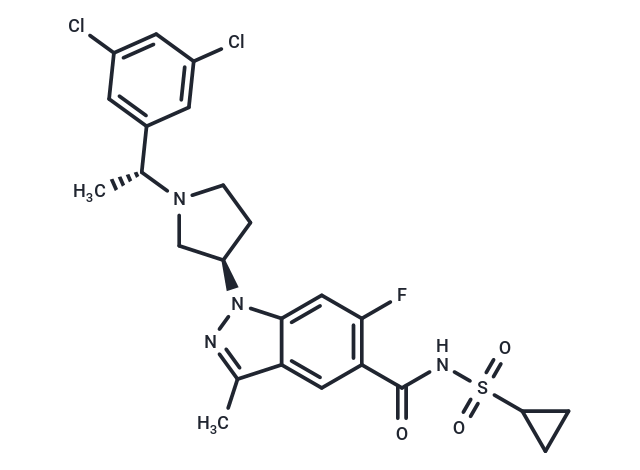
GX-585
CAS No. 2098540-08-8
GX-585( —— )
Catalog No. M36315 CAS No. 2098540-08-8
GX-585 is a sulfonamide analog that is a Nav 1.7 channel inhibitor with analgesic activity for the study of neuropathic pain and inflammation.
Purity : >98% (HPLC)
 COA
Datasheet
HNMR
HPLC
MSDS
Handing Instructions
COA
Datasheet
HNMR
HPLC
MSDS
Handing Instructions
| Size | Price / USD | Stock | Quantity |
| 5MG | 683 | In Stock |


|
| 10MG | 938 | In Stock |
|
| 25MG | 1416 | In Stock |
|
| 50MG | 1841 | In Stock |
|
| 100MG | 2558 | In Stock |
|
| 200MG | Get Quote | In Stock |
|
| 500MG | Get Quote | In Stock |
|
| 1G | Get Quote | In Stock |
|
Biological Information
-
Product NameGX-585
-
NoteResearch use only, not for human use.
-
Brief DescriptionGX-585 is a sulfonamide analog that is a Nav 1.7 channel inhibitor with analgesic activity for the study of neuropathic pain and inflammation.
-
DescriptionGX-585 is a sulfonamide analog that is a Nav 1.7 channel inhibitor with analgesic activity for the study of neuropathic pain and inflammation.
-
In Vitro——
-
In Vivo——
-
Synonyms——
-
PathwayMembrane Transporter/Ion Channel
-
TargetSodium Channel
-
RecptorSodium Channel
-
Research Area——
-
Indication——
Chemical Information
-
CAS Number2098540-08-8
-
Formula Weight539.45
-
Molecular FormulaC24H25Cl2FN4O3S
-
Purity>98% (HPLC)
-
Solubility——
-
SMILESCC=1C=2C(N(N1)[C@H]3CN([C@H](C)C4=CC(Cl)=CC(Cl)=C4)CC3)=CC(F)=C(C(NS(=O)(=O)C5CC5)=O)C2
-
Chemical Name——
Shipping & Storage Information
-
Storage(-20℃)
-
ShippingWith Ice Pack
-
Stability≥ 2 years
Reference
molnova catalog



related products
-
Oxcarbazepine
Oxcarbazepine is structurally a derivative of carbamazepine, adding an extra oxygen atom to the benzylcarboxamide group.
-
Butyl 4-aminobenzoat...
Butamben is a long-duration local anesthetic used for the treatment of chronic pain.
-
PF-05089771
PF-05089771 is a potent, state-dependent, subtype selective Nav1.7 inhibitor with IC50 of 11 nM.
