


 Cart
Cart
 sales@molnova.com



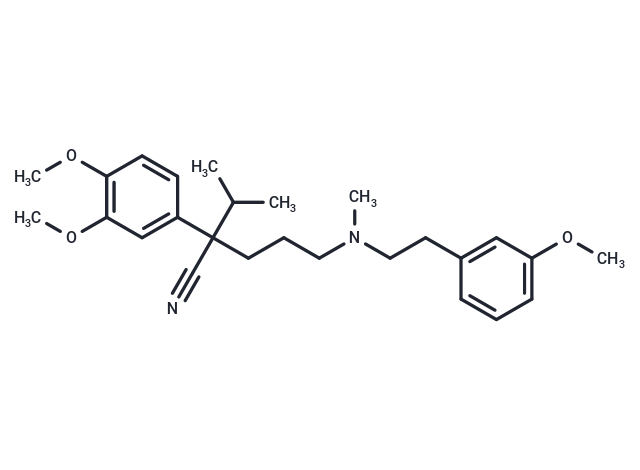
Devapamil
CAS No. 92302-55-1
Devapamil( —— )
Catalog No. M36157 CAS No. 92302-55-1
Devapamil (Devapamilo) is a phenylalkylamine that blocks L-type calcium currents from the inner side of membrane cells in a use-dependent manner.
Purity : >98% (HPLC)
 COA
Datasheet
HNMR
HPLC
MSDS
Handing Instructions
COA
Datasheet
HNMR
HPLC
MSDS
Handing Instructions
| Size | Price / USD | Stock | Quantity |
| 5MG | 171 | In Stock |


|
| 10MG | 247 | In Stock |
|
| 25MG | 481 | In Stock |
|
| 50MG | 632 | In Stock |
|
| 100MG | 900 | In Stock |
|
| 200MG | Get Quote | In Stock |
|
| 500MG | 1795 | In Stock |
|
| 1G | Get Quote | In Stock |
|
Biological Information
-
Product NameDevapamil
-
NoteResearch use only, not for human use.
-
Brief DescriptionDevapamil (Devapamilo) is a phenylalkylamine that blocks L-type calcium currents from the inner side of membrane cells in a use-dependent manner.
-
DescriptionDevapamil (Devapamilo) is a phenylalkylamine that blocks L-type calcium currents from the inner side of membrane cells in a use-dependent manner.
-
In Vitro——
-
In Vivo——
-
Synonyms——
-
PathwayGPCR/G Protein
-
TargetCalcium Channel
-
RecptorCalcium Channel
-
Research Area——
-
Indication——
Chemical Information
-
CAS Number92302-55-1
-
Formula Weight424.58
-
Molecular FormulaC26H36N2O3
-
Purity>98% (HPLC)
-
Solubility——
-
SMILESC(CCCN(CCC1=CC(OC)=CC=C1)C)(C(C)C)(C#N)C2=CC(OC)=C(OC)C=C2
-
Chemical Name——
Shipping & Storage Information
-
Storage(-20℃)
-
ShippingWith Ice Pack
-
Stability≥ 2 years
Reference
molnova catalog



related products
-
Atagabalin HCl
Atagabalin HCl is a novel voltage-dependent calcium channel (VDCC) α2δ subunit (1 and 2) ligand that affects slow-wave sleep and can be used to treat insomnia.
-
PD173212
PD 173212 is a blocker that blocks N-type voltage sensitive calcium channel (Cav2.2). PD173212 (0.0017-1.7 μmol/kg, Intraperitoneal Injection.) dose-dependently reduced DNBS-induced visceral hypersensitivity in mice.
-
SR33805
SR33805 is a potent antagonist of Ca2+ channel(EC50s of 4.1 nM and 33 nM in depolarized and polarized conditions, respectively)Acute treatment with SR33805 restored the MI-altered cell shortening without affecting the Ca(2+) transient amplitude, suggesting an increase of myofilament Ca(2+) sensitivity in MI myocytes.?
