


 Cart
Cart
 sales@molnova.com



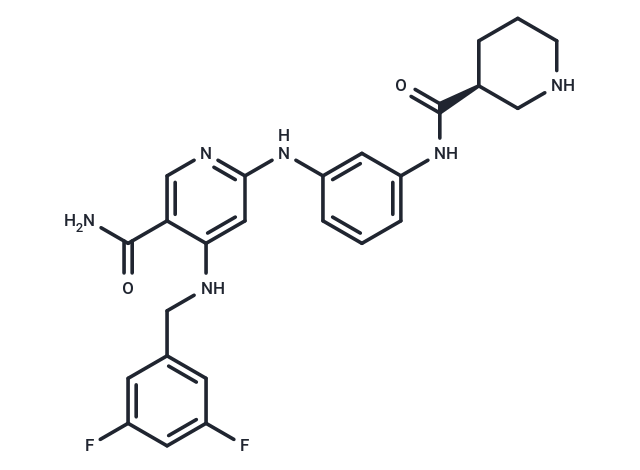
Nimucitinib
CAS No. 2740557-24-6
Nimucitinib( —— )
Catalog No. M36068 CAS No. 2740557-24-6
Nimucitinib is a Janus kinase (JAK) inhibitor that can be used to treat dry eye and promote tear production.
Purity : >98% (HPLC)
 COA
Datasheet
HNMR
HPLC
MSDS
Handing Instructions
COA
Datasheet
HNMR
HPLC
MSDS
Handing Instructions
| Size | Price / USD | Stock | Quantity |
| 2MG | 135 | In Stock |


|
| 5MG | 227 | In Stock |
|
| 10MG | 353 | In Stock |
|
| 25MG | 654 | In Stock |
|
| 50MG | 918 | In Stock |
|
| 100MG | 1423 | In Stock |
|
| 200MG | Get Quote | In Stock |
|
| 500MG | 2762 | In Stock |
|
| 1G | Get Quote | In Stock |
|
Biological Information
-
Product NameNimucitinib
-
NoteResearch use only, not for human use.
-
Brief DescriptionNimucitinib is a Janus kinase (JAK) inhibitor that can be used to treat dry eye and promote tear production.
-
DescriptionNimucitinib is a Janus kinase (JAK) inhibitor.
-
In Vitro——
-
In Vivo——
-
Synonyms——
-
PathwayAngiogenesis
-
TargetJAK
-
RecptorJAK
-
Research Area——
-
Indication——
Chemical Information
-
CAS Number2740557-24-6
-
Formula Weight480.51
-
Molecular FormulaC25H26F2N6O2
-
Purity>98% (HPLC)
-
SolubilityIn Vitro:?DMSO : 125 mg/mL (260.14 mM; Ultrasonic )
-
SMILESN(CC1=CC(F)=CC(F)=C1)C=2C(C(N)=O)=CN=C(NC3=CC(NC(=O)[C@H]4CCCNC4)=CC=C3)C2
-
Chemical Name——
Shipping & Storage Information
-
Storage(-20℃)
-
ShippingWith Ice Pack
-
Stability≥ 2 years
Reference
1. WHO Drug Information, Vol. 36, No. 4, 2022.
molnova catalog



related products
-
PF-04965842
PF-04965842 (Abrocitinib, PF04965842) is a potent, selective, orally bioavailable JAK1 inhibitor with IC50 of 29 nM.
-
JAK-IN-5 hydrochlori...
JAK-IN-5 hydrochloride is an inhibitor of JAK.
-
AS 2553627
AS 2553627 (AS2553627)?is a novel potent, selective pan-JAK inhibitor.
