


 Cart
Cart
 sales@molnova.com



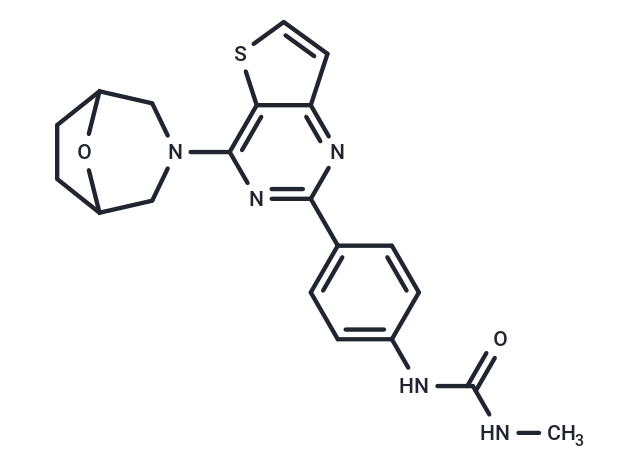
mTOR inhibitor 9a
CAS No. 1144075-32-0
mTOR inhibitor 9a( —— )
Catalog No. M35933 CAS No. 1144075-32-0
mTOR inhibitor 9a inhibited the growth of human LNCap cells with an ic50 of 80 nm. 1-methyl-3 -{4-[4-(8-oxa-3-azabicyclo[3.2.1]oct-3-yl)thieno[3,2-d]pyrimidin-2-yl]phenyl}urea may have antitumor activity.
Purity : >98% (HPLC)
 COA
Datasheet
HNMR
HPLC
MSDS
Handing Instructions
COA
Datasheet
HNMR
HPLC
MSDS
Handing Instructions
| Size | Price / USD | Stock | Quantity |
| 5MG | 331 | In Stock |


|
| 10MG | 451 | In Stock |
|
| 25MG | 634 | In Stock |
|
| 50MG | 768 | In Stock |
|
| 100MG | 977 | In Stock |
|
| 200MG | 1274 | In Stock |
|
| 500MG | Get Quote | In Stock |
|
| 1G | Get Quote | In Stock |
|
Biological Information
-
Product NamemTOR inhibitor 9a
-
NoteResearch use only, not for human use.
-
Brief DescriptionmTOR inhibitor 9a inhibited the growth of human LNCap cells with an ic50 of 80 nm. 1-methyl-3 -{4-[4-(8-oxa-3-azabicyclo[3.2.1]oct-3-yl)thieno[3,2-d]pyrimidin-2-yl]phenyl}urea may have antitumor activity.
-
DescriptionmTOR inhibitor 9a inhibited the growth of human LNCap cells with an ic50 of 80 nm. 1-methyl-3 -{4-[4-(8-oxa-3-azabicyclo[3.2.1]oct-3-yl)thieno[3,2-d]pyrimidin-2-yl]phenyl}urea may have antitumor activity.
-
In Vitro——
-
In Vivo——
-
Synonyms——
-
PathwayOthers
-
TargetOther Targets
-
RecptorOthers
-
Research Area——
-
Indication——
Chemical Information
-
CAS Number1144075-32-0
-
Formula Weight395.48
-
Molecular FormulaC20H21N5O2S
-
Purity>98% (HPLC)
-
Solubility——
-
SMILESN(C(NC)=O)C1=CC=C(C2=NC(=C3C(=N2)C=CS3)N4CC5OC(C4)CC5)C=C1
-
Chemical Name——
Shipping & Storage Information
-
Storage(-20℃)
-
ShippingWith Ice Pack
-
Stability≥ 2 years
Reference
molnova catalog



related products
-
Kalopanaxsaponin H
Macranthoside A is a triterpenoid glycoside extracted from rehmannia and belongs to the iridoterpenoid synthesis.
-
H-Arg-Asn-Ile-Ala-Gl...
H-Arg-Asn-Ile-Ala-Glu-Ile-Ile-Lys-Asp-Ile-OH
-
Acetyl-(Leu28·31)-Ne...
N-Acetyl [Leu28, Leu31] neuropeptide Y (24–36) is a selective agonist of neuropeptide Y Y2 receptor. N-Acetyl [Leu28, Leu31] neuropeptide Y (24–36) attenuates cardiac vagal action in anaesthetised rats.
