


 Cart
Cart
 sales@molnova.com



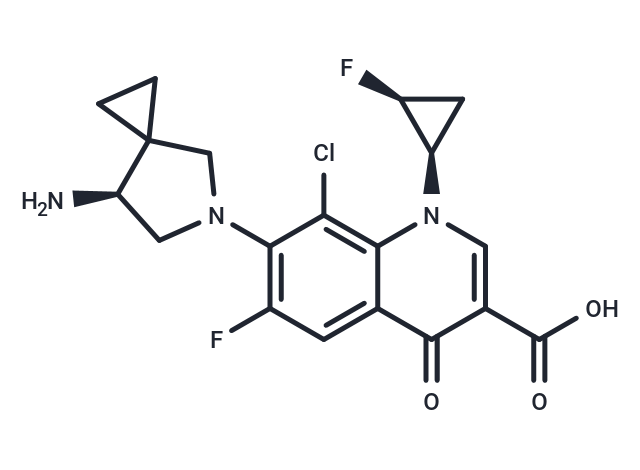
Sitafloxacin
CAS No. 127254-12-0
Sitafloxacin( —— )
Catalog No. M35721 CAS No. 127254-12-0
Sitafloxacin (Sitafloxacin anhydrous) is an orally active fluoroquinolone antibiotic with broad-spectrum antimicrobial activity.Sitafloxacin has been used in the study of respiratory tract infections and urinary tract infections.
Purity : >98% (HPLC)
 COA
Datasheet
HNMR
HPLC
MSDS
Handing Instructions
COA
Datasheet
HNMR
HPLC
MSDS
Handing Instructions
| Size | Price / USD | Stock | Quantity |
| 2MG | 33 | In Stock |


|
| 5MG | 53 | In Stock |
|
| 10MG | 86 | In Stock |
|
| 25MG | 141 | In Stock |
|
| 50MG | 207 | In Stock |
|
| 100MG | 309 | In Stock |
|
| 200MG | 458 | In Stock |
|
| 500MG | Get Quote | In Stock |
|
| 1G | Get Quote | In Stock |
|
Biological Information
-
Product NameSitafloxacin
-
NoteResearch use only, not for human use.
-
Brief DescriptionSitafloxacin (Sitafloxacin anhydrous) is an orally active fluoroquinolone antibiotic with broad-spectrum antimicrobial activity.Sitafloxacin has been used in the study of respiratory tract infections and urinary tract infections.
-
DescriptionSitafloxacin (DU6859a) is a potent, orally active fluoroquinolone antibiotic. Sitafloxacin shows antichlamydial activity and antibacterial activities against a broad range of gram-positive and gram-negative bacteria, including anaerobic bacteria, as well as against atypical pathogens. Sitafloxacin can be used for the research of respiratory tract infection and urinary tract infection.
-
In VitroSitafloxacin (DU6859a) shows antibacterial activities with MIC of 0.03, 0.12, 0.06 mg/L for wild-type ATCC 49619, gyrA mutant SP39, parCmutant 1026523 streptococcus pneumoniae stran, respectively. Sitafloxacin (DU6859a) shows antibacterial activities for quinolone-susceptible strains of streptococcus pneumoniae with MIC of 0.03, 0.03 mg/L for EG 00093 and EG 00218 strain, respectively.Sitafloxacin (DU6859a) shows inhibition for DNA gyrase and topoisomerase IV (TopoIV) with >IC50s of 4.38, 3.12 mg/L, respectively.
-
In VivoSitafloxacin (DU-6859a) (12.5-100 mg/kg; i.g.; daily for 4 weeks; BALB/c female mice) has antibacterial activity. M. ulcerans cells could be isolated from the inoculated footpads and there was no evidence of footpad swelling.Animal Model:BALB/c female mice Dosage:12.5, 25, 50 and 100 mg/kg Administration:Oral gavage; daily, for 4 weeks Result:Inhibits the growth of Mycobacterium ulcerans and the M. ulcerans cells.
-
Synonyms——
-
PathwayMicrobiology/Virology
-
TargetAntibiotic
-
RecptorAntibiotic
-
Research Area——
-
Indication——
Chemical Information
-
CAS Number127254-12-0
-
Formula Weight409.81
-
Molecular FormulaC19H18ClF2N3O3
-
Purity>98% (HPLC)
-
Solubility——
-
SMILESN[C@H]1C2(CN(C1)C=3C(Cl)=C4N(C=C(C(O)=O)C(=O)C4=CC3F)[C@H]5[C@@H](F)C5)CC2
-
Chemical Name——
Shipping & Storage Information
-
Storage(-20℃)
-
ShippingWith Ice Pack
-
Stability≥ 2 years
Reference
1. Okumura R, et al. Dual-targeting properties of the 3-aminopyrrolidyl quinolones, DC-159a and sitafloxacin, against DNA gyrase and topoisomerase IV: contribution to reducing in vitro emergence of quinolone-resistant Streptococcus pneumoniae. J Antimicrob Chemother. 2008 Jul;62(1):98-104.?
molnova catalog



related products
-
Dalfopristin
Dalfopristin is a semi-synthetic streptogramin antibiotic.
-
CRK12-IN-1
CRK12-IN-1 is a potent CRK12 inhibitor with insecticidal activity and exhibits inhibitory effects on Trypanosoma brucei (T.b. brucei) and Trypanosoma congolense (T. congolense) with EC50s of 1.3 and 18 nM, respectively, rapidly killing the pathogenic cells.
-
Adenosine 5-monophos...
Adenosine 5'-monophosphate disodium salt (Adenosine Phosphate Disodium) is a purine nucleotide involved in ATP metabolism and is used to study the effects of ATP on cells and organisms.
