


 Cart
Cart
 sales@molnova.com



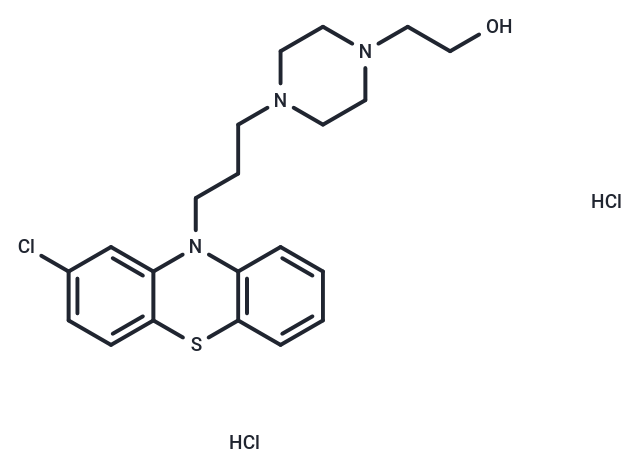
Perphenazine dihydrochloride
CAS No. 2015-28-3
Perphenazine dihydrochloride( —— )
Catalog No. M35697 CAS No. 2015-28-3
Perphenazine dihydrochloride is an orally active dopamine receptor and histamine-1 receptor antagonist that acts on D2 (Ki: 0.56 nM), D3 (Ki: 0.43 nM), and 5-HT2A (Ki: 0.6 nM) receptors, and also binds Alpha-1A adrenergic receptors.
Purity : >98% (HPLC)
 COA
Datasheet
HNMR
HPLC
MSDS
Handing Instructions
COA
Datasheet
HNMR
HPLC
MSDS
Handing Instructions
| Size | Price / USD | Stock | Quantity |
| 5MG | 411 | In Stock |


|
| 10MG | 562 | In Stock |
|
| 25MG | 866 | In Stock |
|
| 50MG | 1097 | In Stock |
|
| 100MG | 1469 | In Stock |
|
| 200MG | Get Quote | In Stock |
|
| 500MG | Get Quote | In Stock |
|
| 1G | Get Quote | In Stock |
|
Biological Information
-
Product NamePerphenazine dihydrochloride
-
NoteResearch use only, not for human use.
-
Brief DescriptionPerphenazine dihydrochloride is an orally active dopamine receptor and histamine-1 receptor antagonist that acts on D2 (Ki: 0.56 nM), D3 (Ki: 0.43 nM), and 5-HT2A (Ki: 0.6 nM) receptors, and also binds Alpha-1A adrenergic receptors.
-
DescriptionPerphenazine dihydrochloride is an orally active dopamine receptor and histamine-1 receptor antagonist, with Ki values of 0.56 nM (D2), 0.43 nM (D3), 6 nM (5-HT2A), respectively. Perphenazine dihydrochloride also binds to Alpha-1A adrenergic receptor. Perphenazine dihydrochloride inhibits cancer cell proliferation, and induces apoptosis. Perphenazine dihydrochloride can be used in the research of mental disease, cancer, inflammation.
-
In VitroPerphenazine (40 μM, 48 h) dihydrochloride inhibits cell viability, and induces cell apoptosis mediated by CTSD (Cathepsin D) in L02 cells.Perphenazine (30 μM, 24 h) dihydrochloride induces intense lysosome vacuolation, impaired lysosomal membrane, and induces lysosomal membrane permeabilization (LMP), ultimately triggering lysosomal cell death in L02 cells.Perphenazine (10-40 μM, 24 h) dihydrochloride inhibits autophagic flux in L02 cells.Perphenazine (1 μM, 24 h) dihydrochloride decreases glioblastoma U-87 MG cell migration and invasion.Cell Viability Assay Cell Line:L02 cells Concentration:10-100 μM Incubation Time:12, 24, 48 h Result:Inhibited cell viability in a concentration and time-dependent manner.Western Blot AnalysisCell Line:L02 cells Concentration:10, 20, 30, and 40 μM Incubation Time:24 h Result:Increased LC3 I/II and P62/SQSTM1 levelsCell Migration Assay Cell Line:U-87 MG cells Concentration:0, 3, 6, 9, 12, and 24 h Incubation Time:0, 3, 6, 9, 12, and 24 h Result:Increased the wound closure in human glioblastoma cell cultures from 24.6 to 62.7%.
-
In VivoPerphenazine (oral gavage, 180 mg/kg, every other day for 21 days) dihydrochloride induces liver injury and lysosomal membrane damage in ICR mice.Perphenazine (oral administration, 10 mg/kg, every other day for 6 days) dihydrochloride attenuates morphological phenotype in mouse models of Th2-type allergic dermatitis.Animal Model:ICR mice Dosage:10, 30, 60, 120, 180 mg/kg Administration:Oral gavage, every other day for 21 days.Result:Increased histological injury and aminotransferases compared with control.Animal Model:Oxazolone-treated animal model of dermatitis Dosage:10 mg/kg Administration:Oral administration, every other day for 6 days Result:Decreased The levels of mice ear swelling.
-
Synonyms——
-
PathwayGPCR/G Protein
-
TargetDopamine Receptor
-
RecptorDopamine Receptor | 5-HT Receptor | Apoptosis | Histamine Receptor
-
Research Area——
-
Indication——
Chemical Information
-
CAS Number2015-28-3
-
Formula Weight476.89
-
Molecular FormulaC21H28Cl3N3OS
-
Purity>98% (HPLC)
-
Solubility——
-
SMILESClC1=CC=C2SC3=C(N(CCCN4CCN(CC4)CCO)C2=C1)C=CC=C3.Cl.Cl
-
Chemical Name——
Shipping & Storage Information
-
Storage(-20℃)
-
ShippingWith Ice Pack
-
Stability≥ 2 years
Reference



-
MLS1547
MLS1547 is a highly efficacious agonist of G protein-biased dopamine D2 receptor with a Ki of 1.2 μM. MLS1547 stimulates D2R G protein-mediated signaling with EC50 of 0.37 μM in a calcium mobilization assay.
-
SKF-83566
SKF-83566 is a blood-brain permeable and orally active antagonist of D1-like dopamine receptor and a weaker competitive 5-HT2 receptor antagonist with Ki of 11 nMSKF-83566 caused a concentration-dependent increase in peak single-pulse evoked extracellular DA concentration, with a maximum increase of 65% in 5 μM SKF-83566.?
-
SKF83959
SKF83959, a benzazepine analog, is a selective and potent partial agonist of the dopamine D1 receptor with Ki values of 1.18, 7.56, 920, and 399 nM for rat D1, D5, D2, and D3 receptors, respectively.
