


 Cart
Cart
 sales@molnova.com



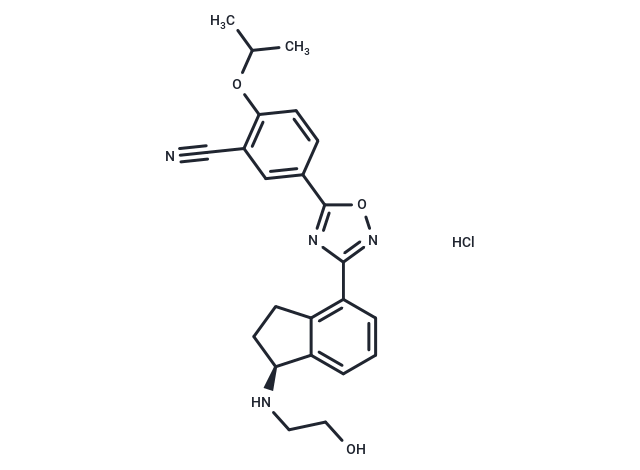
Ozanimod hydrochloride
CAS No. 1618636-37-5
Ozanimod hydrochloride( —— )
Catalog No. M35654 CAS No. 1618636-37-5
Ozanimod hydrochloride (RPC-1063 hydrochloride) is an orally available, selective and potent sphingosine 1-phosphate (S1P) receptor modulator that shows high affinity for S1P1 and S1P5.
Purity : >98% (HPLC)
 COA
Datasheet
HNMR
HPLC
MSDS
Handing Instructions
COA
Datasheet
HNMR
HPLC
MSDS
Handing Instructions
| Size | Price / USD | Stock | Quantity |
| 1 mL x 10 mM in DMSO | 103 | In Stock |


|
| 5MG | 93 | In Stock |
|
| 10MG | 140 | In Stock |
|
| 25MG | 282 | In Stock |
|
| 50MG | 445 | In Stock |
|
| 100MG | 641 | In Stock |
|
| 200MG | 905 | In Stock |
|
| 500MG | Get Quote | In Stock |
|
| 1G | Get Quote | In Stock |
|
Biological Information
-
Product NameOzanimod hydrochloride
-
NoteResearch use only, not for human use.
-
Brief DescriptionOzanimod hydrochloride (RPC-1063 hydrochloride) is an orally available, selective and potent sphingosine 1-phosphate (S1P) receptor modulator that shows high affinity for S1P1 and S1P5.
-
DescriptionOzanimod (RPC-1063) hydrochloride, a sphingosine 1-phosphate (S1P) receptor modulator that binds with high affinity selectively to S1P receptor subtypes 1 (S1P1) and 5 (S1P5). Ozanimod hydrochloride has modulate effect for hS1P1 and hS1P5 receptor with EC50s of 1.03 nM and 8.6 nM, respectively. Ozanimod hydrochloride can be used for the research of relapsing multiple sclerosis (MS) .
-
In VitroOzanimod (RPC-1063) hydrochloride has potency and intrinsic activity of S1P receptor modulators for S1P5 across species with [35S]-GTPgS binding, and the EC50 values of 1.03 nM, 1.29 nM, 0.90 nM, 1.02 nM and 0.61 nM for Human S1P1, Cynomolgus monkey S1P1, Mouse S1P1, Rat S1P1 and Canine S1P1, respectively; and the EC50 values of 8.6 nM, 15.9 nM, 957.5 nM, 2032.7 nM and 1662.0 nM for Human S1P5, Cynomolgus monkey S1P5, Mouse S1P5, Rat S1P5 and Canine S1P5,respectively. Ozanimod hydrochloride restores the potency with EC50 from 958 nM for mS1P5 to 6.7 nM for mS1P5_A120T to closely mirror the EC50 for hS1P5 of 8.6 nM by mutating the alanine in the mouse sequence.Ozanimod hydrochloride has binding affinity with Ki values of 2.0 nM, 59.9 nM and 5.6 nM forhS1P5, mS1P5 and mS1P5 _A120T, respectively.Ozanimod hydrochloride has saturation binding of [3H]-ozanimod to hS1P5, and mS1P5_A120T with KD values of 6.56 nM, 7.35 nM, respectively and also has saturation binding for [3H]-A971432 to S1P5D valueof 8.75 nM.
-
In VivoOzanimod (RPC-1063) hydrochloride (oral gavage; 0.05, 0.2, or 1 mg/kg; once daily; for 14 consecutive days) exposures sufficient to engage S1P1, but not S1P5, resulted in reduced circulating lymphocytes, disease scores, and body weight loss; reduced inflammation, demyelination, and apoptotic cell counts in the spinal cord; and reduced circulating levels of the neuronal degeneration marker, neurofilament light.Ozanimod hydrochloride (oral gavage; 5 mg/kg; once-daily) prevented axonal degradation and myelin loss during toxin challenge but did not facilitate enhanced remyelination after intoxication.Ozanimod hydrochloride (oral, 1 or 5 mg/kg, for 7 days) has good pharmacokinetics in mice.Animal Model:Experimental Autoimmune Encephalomyelitis Model Dosage:0.05, 0.2, or 1 mg/kg Administration:oral gavage; 0.05, 0.2, or 1 mg/kg; once daily; for 14 consecutive days Result:Attenuated body weight loss, terminal disease scores were significantly attenuated with the 0.2 and 1 mg/kg doses and ALCs were significantly reduced in all dose groups. Reduced spinal cord inflammation and demyelination, as well as attenuated the number of spinal cord apoptotic cells, and significantly reduced the levels of circulating neurofilament light at the top dose of 1 mg/kg.Animal Model:Cuprizone/Rapamycin Demyelination Model Dosage:5 mg/kg Administration:oral gavage; 5 mg/kg; once-daily Result:Protected neuronal axons, preventing breakage and ovoid formation in the corpus callosum of CPZ/Rapa treated mice.Significantly attenuated the extent to which the corpus callosum demonstrated reduced myelin content as visualized by MRI.
-
Synonyms——
-
PathwayGPCR/G Protein
-
TargetS1P Receptor
-
RecptorS1P Receptor
-
Research Area——
-
Indication——
Chemical Information
-
CAS Number1618636-37-5
-
Formula Weight440.92
-
Molecular FormulaC23H25ClN4O3
-
Purity>98% (HPLC)
-
SolubilityIn Vitro:?DMSO : 200 mg/mL (453.60 mM; Ultrasonic )
-
SMILESN(CCO)[C@@H]1C=2C(=C(C=CC2)C=3N=C(ON3)C4=CC(C#N)=C(OC(C)C)C=C4)CC1.Cl
-
Chemical Name——
Shipping & Storage Information
-
Storage(-20℃)
-
ShippingWith Ice Pack
-
Stability≥ 2 years
Reference
1. Julie V Selkirk, et al. Deconstructing the Pharmacological Contribution of Sphingosine-1 Phosphate Receptors to Mouse Models of Multiple Sclerosis Using the Species Selectivity of Ozanimod, a Dual Modulator of Human Sphingosine 1-Phosphate Receptor Subtyp?
molnova catalog



related products
-
JTE-013
JTE-013 is an effective and specific antagonist of S1P2. JTE-013 suppresses the specific binding of radiolabeled S1P to human and rat S1P2 (IC50s: 17 nM and 22 nM, respectively).JTE-013 is a S1P2 antagonist. JTE-013 (50-200 μM;?1-3 days) decreased cell viability.
-
XL413
XL-413 is an orally bioavailable cell division cycle 7 homolog (CDC7) kinase inhibitor with potential antineoplastic activity.
-
WAY-272077
WAY-272077 is a sphingosine kinase inhibitor with anti-inflammatory, antitumor and hemostatic effects.
