


 Cart
Cart
 sales@molnova.com



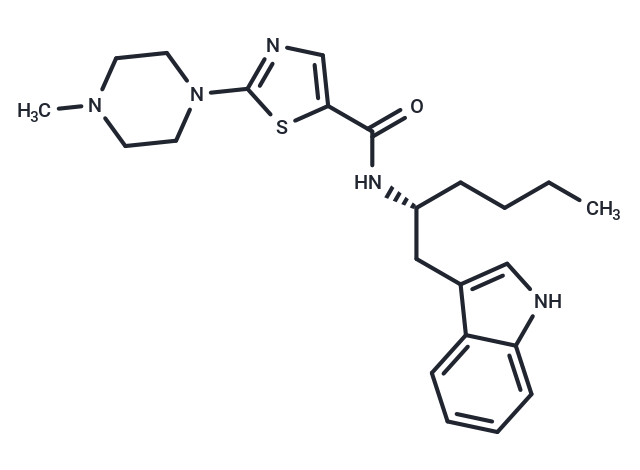
Minzasolmin
CAS No. 1802518-92-8
Minzasolmin( —— )
Catalog No. M35629 CAS No. 1802518-92-8
Minzasolmin(DLX-313) is an alpha-synuclein misfolding inhibitor for the study of Parkinson's disease.
Purity : >98% (HPLC)
 COA
Datasheet
HNMR
HPLC
MSDS
Handing Instructions
COA
Datasheet
HNMR
HPLC
MSDS
Handing Instructions
| Size | Price / USD | Stock | Quantity |
| 5MG | 588 | In Stock |


|
| 10MG | 939 | In Stock |
|
| 25MG | 1691 | In Stock |
|
| 50MG | 2465 | In Stock |
|
| 100MG | Get Quote | In Stock |
|
| 200MG | Get Quote | In Stock |
|
| 500MG | Get Quote | In Stock |
|
| 1G | Get Quote | In Stock |
|
Biological Information
-
Product NameMinzasolmin
-
NoteResearch use only, not for human use.
-
Brief DescriptionMinzasolmin(DLX-313) is an alpha-synuclein misfolding inhibitor for the study of Parkinson's disease.
-
DescriptionMinzasolmin is an alpha-synuclein oligomerization inhibitor.
-
In Vitro——
-
In Vivo——
-
Synonyms——
-
PathwayOthers
-
TargetOther Targets
-
RecptorOthers
-
Research Area——
-
Indication——
Chemical Information
-
CAS Number1802518-92-8
-
Formula Weight425.59
-
Molecular FormulaC23H31N5OS
-
Purity>98% (HPLC)
-
Solubility——
-
SMILESC([C@H](NC(=O)C=1SC(=NC1)N2CCN(C)CC2)CCCC)C=3C=4C(NC3)=CC=CC4
-
Chemical Name——
Shipping & Storage Information
-
Storage(-20℃)
-
ShippingWith Ice Pack
-
Stability≥ 2 years
Reference
1. International Nonproprietary Names for Pharmaceutical Substances (INN). WHO Drug Information, Vol. 35, No. 4, 2021.
molnova catalog



related products
-
Dihydrocapsiate
Dihydrocapsiate (Standard) is the analytical standard of Dihydrocapsiate. This product is intended for research and analytical applications. Dihydrocapsiate, as a compound of capsinoid family, is an orally active TRPV1 agonist. Dihydrocapsiate can be used for the research of metabolism disease.
-
MCH-Gene-Overprinted...
MCH-Gene-Overprinted-Polypeptide-14 (rat)
-
N-Formyl-L-methionin...
Effective in the initiation of protein synthesis. The initiating methionine residue enters the ribosome as N-formyl methionyl tRNA. This process occurs in Escherichia coli and other bacteria as well as in the mitochondria of eukaryotic cells.
