


 Cart
Cart
 sales@molnova.com



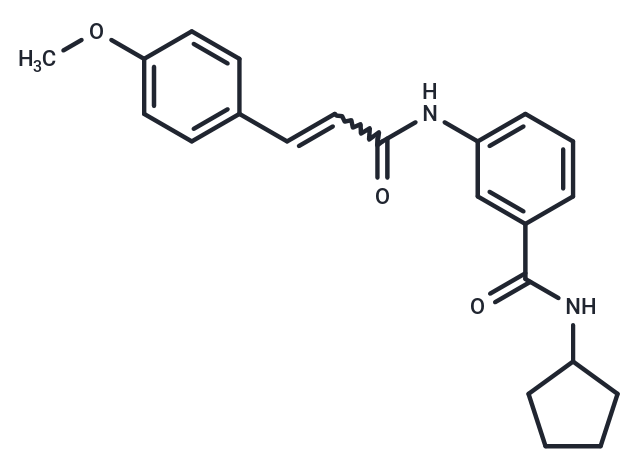
TGFβ1-IN-1
CAS No. 2348795-14-0
TGFβ1-IN-1( —— )
Catalog No. M35554 CAS No. 2348795-14-0
TGFβ1-IN-1 is an orally active TGF-β1 inhibitor that inhibits the production of TGF-β1-induced fibrotic markers (α-SMA and fibronectin) and can be used for the study of cancer and autoimmune diseases.
Purity : >98% (HPLC)
 COA
Datasheet
HNMR
HPLC
MSDS
Handing Instructions
COA
Datasheet
HNMR
HPLC
MSDS
Handing Instructions
| Size | Price / USD | Stock | Quantity |
| 1 mL x 10 mM in DMSO | 120 | In Stock |


|
| 5MG | 107 | In Stock |
|
| 10MG | 180 | In Stock |
|
| 25MG | 359 | In Stock |
|
| 50MG | 576 | In Stock |
|
| 100MG | 923 | In Stock |
|
| 200MG | 1237 | In Stock |
|
| 500MG | Get Quote | In Stock |
|
| 1G | Get Quote | In Stock |
|
Biological Information
-
Product NameTGFβ1-IN-1
-
NoteResearch use only, not for human use.
-
Brief DescriptionTGFβ1-IN-1 is an orally active TGF-β1 inhibitor that inhibits the production of TGF-β1-induced fibrotic markers (α-SMA and fibronectin) and can be used for the study of cancer and autoimmune diseases.
-
DescriptionTGFβ1-IN-1 (compound 42) is a potent, orally active TGF-β1 inhibitor. TGFβ1-IN-1 inhibits the upregulation of TGF-β1-induced fibrosis markers (α-SMA and fibronectin) and can be used in liver fibrosis disease studies.
-
In VitroTGFβ1-IN-1 (compound 42) (0-20 μM, 72 h) inhibits the proliferation of TGF-β1 (5 ng/mL)-treated LX- 2 cells and inhibits LO2 cell viability with an IC 50 of 105 μM.Cell Viability Assay Cell Line:HSCs (LX-2) cells Concentration:20 μM Incubation Time:24 or 72 hours Result:Showed the survival rate of 77.5% and the inhibition rate of 30.3% for LX-2 cells.Significantly inhibited fibronectin and α-SMA protein expression.
-
In VivoTGFβ1-IN-1 (compound 42) (p.o., 15 or 30 mg/kg, daily, 3weeks) prevents CCl4-induced liver injury and fibrosis, inhibits the activation of hepatic stellate cell (HSC) and epithelial-mesenchymal transition (EMT), and improves the immune microenvironment of CCl4-induced liver fibrosis as well as CCl4-induced systemic toxicity in C57BL/6J mice.Animal Model:Liver fibrosis C57BL/6J mice induced by CCl4 Dosage:15 or 30 mg/kg Administration: Oral administration; daily; 3 weeks Result:Significantly prevented CCl4-induced liver injury and reduced liver weight factor, serum ALT, AST, CHO and TG levels.Significantly improved structural damage and inflammatory cell infiltration in the liver, and reduced collagen deposition in liver tissue.Reduced accumulation of CCl4-induced immune cells, such as hepatic macrophages (F4/80+ CD11b+), Th1 cells (CD69+ CD4+), and Th2 cells (CD69+ CD8+) so on.
-
Synonyms——
-
PathwayOthers
-
TargetOther Targets
-
RecptorTGF-beta/Smad
-
Research Area——
-
Indication——
Chemical Information
-
CAS Number2348795-14-0
-
Formula Weight364.438
-
Molecular FormulaC22H24N2O3
-
Purity>98% (HPLC)
-
SolubilityIn Vitro:?DMSO : 100 mg/mL (274.39 mM; Ultrasonic )
-
SMILESO=C(C=CC1=CC=C(OC)C=C1)NC2=CC=CC(=C2)C(=O)NC3CCCC3
-
Chemical Name——
Shipping & Storage Information
-
Storage(-20℃)
-
ShippingWith Ice Pack
-
Stability≥ 2 years
Reference
1. Lin Yue, et al. Discovery and evaluation of phenacrylanilide derivatives as novel potential anti-liver fibrosis agents. Eur J Med Chem. 2022 Nov 15;242:114685.?
molnova catalog



related products
-
Quercetin-3-O-D-gluc...
Quercetin-3-O-D-glucosyl]-(1-2)-L-rhamnoside is main antioxidant from Shuxuening, an herbal medicines injection.
-
6-NBDG
6-NBDG, a fluorescent glucose analogue, can be used as a fluorescent probe.6-NBDG can be used for monitoring glucose transport and uptake. 6-NBDG can be used as for detecting macrophage-rich atherosclerotic plaques.
-
Trachelanthine
Trachelanthine is a natural product from Eupatorium fortunei.
