


 Cart
Cart
 sales@molnova.com



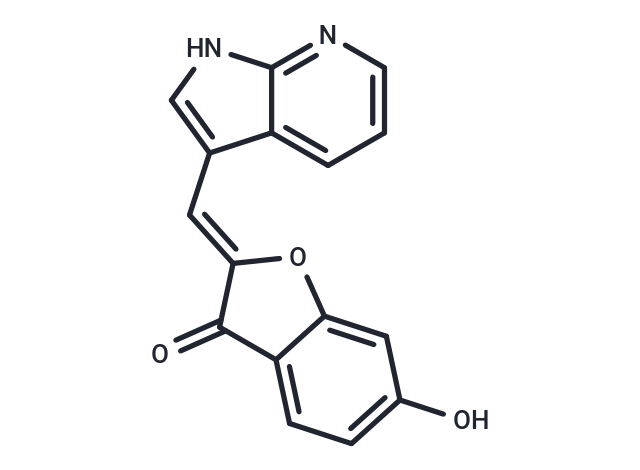
Haspin-IN-3
CAS No. 2416569-95-2
Haspin-IN-3( —— )
Catalog No. M35430 CAS No. 2416569-95-2
Haspin-IN-3 is a potent haspin inhibitor with an IC50 of 14 nM.Haspin-IN-3 has anticancer activity.
Purity : >98% (HPLC)
 COA
Datasheet
HNMR
HPLC
MSDS
Handing Instructions
COA
Datasheet
HNMR
HPLC
MSDS
Handing Instructions
| Size | Price / USD | Stock | Quantity |
| 5MG | 102 | In Stock |


|
| 10MG | 164 | In Stock |
|
| 25MG | 281 | In Stock |
|
| 50MG | 411 | In Stock |
|
| 100MG | 551 | In Stock |
|
| 200MG | 728 | In Stock |
|
| 500MG | Get Quote | In Stock |
|
| 1G | Get Quote | In Stock |
|
Biological Information
-
Product NameHaspin-IN-3
-
NoteResearch use only, not for human use.
-
Brief DescriptionHaspin-IN-3 is a potent haspin inhibitor with an IC50 of 14 nM.Haspin-IN-3 has anticancer activity.
-
DescriptionHaspin-IN-3 (compound 8l) is a potent haspin inhibitor with IC50 of 14 nM. Haspin-IN-3 has anticancer effects.
-
In Vitro——
-
In Vivo——
-
Synonyms——
-
PathwayOthers
-
TargetOther Targets
-
RecptorHaspin Kinase
-
Research Area——
-
Indication——
Chemical Information
-
CAS Number2416569-95-2
-
Formula Weight278.26
-
Molecular FormulaC16H10N2O3
-
Purity>98% (HPLC)
-
SolubilityIn Vitro:?DMSO : 25 mg/mL (89.84 mM; Ultrasonic (<60°C)
-
SMILESOc1ccc2C(=O)\C(Oc2c1)=C\c1c[nH]c2ncccc12
-
Chemical Name——
Shipping & Storage Information
-
Storage(-20℃)
-
ShippingWith Ice Pack
-
Stability≥ 2 years
Reference
1. Malikotsi A Qhobosheane, et al. Synthesis and evaluation of 7-azaindole derivatives bearing benzocycloalkanone motifs as protein kinase inhibitors. Bioorg Med Chem. 2020 Jun 1;28(11):115468. ?
molnova catalog



related products
-
Eledoisin trifluoroa...
Eledoisin is a peptide extracted from the posterior salivary glands of certain small octopi (Eledone spp., Mollusca), or obtained by synthesis.?Its actions resemble those of SUBSTANCE P;?it is a potent vasodilator and increases capillary permeability.
-
Litifilimab
Litifilimab, a humanized IgG1-κ antibody, targets the C-type lectin domain family 4 member C (CLEC4C) and has potential applications in the study of cutaneous lupus erythematosus (CLE) .
-
(S)-3-(4-Hydroxyphen...
(S)-3-(4-Hydroxyphenyl)-2-hydroxypropionic acid (compound 1) is a metabolite isolated from the culture medium of Leuconostoc mesenteroides.
