


 Cart
Cart
 sales@molnova.com



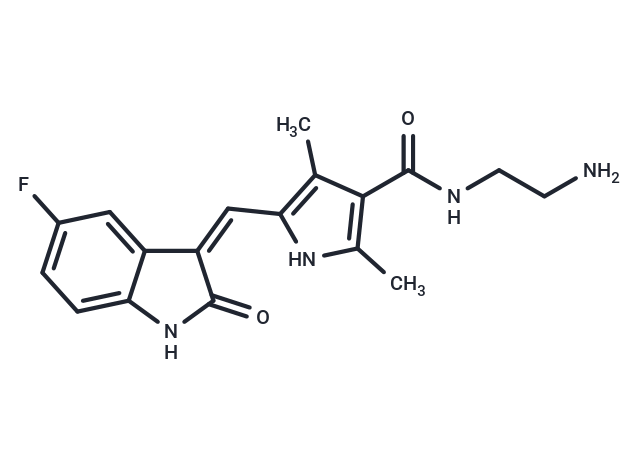
N,N-Didesethyl Sunitinib Hydrochloride
CAS No. 873077-70-4
N,N-Didesethyl Sunitinib Hydrochloride( —— )
Catalog No. M35336 CAS No. 873077-70-4
N,N-Didesethyl Sunitinib Hydrochloride is a potent AMPK inhibitor with IC50 of 393 nM and 141 nM for AMPKα1 and AMPK2,respectively.
Purity : >98% (HPLC)
 COA
Datasheet
HNMR
HPLC
MSDS
Handing Instructions
COA
Datasheet
HNMR
HPLC
MSDS
Handing Instructions
| Size | Price / USD | Stock | Quantity |
| 1 mL x 10 mM in DMSO | 337 | In Stock |


|
| 5MG | 330 | In Stock |
|
| 10MG | 464 | In Stock |
|
| 25MG | 753 | In Stock |
|
| 50MG | 1004 | In Stock |
|
| 100MG | 1376 | In Stock |
|
| 200MG | Get Quote | In Stock |
|
| 500MG | Get Quote | In Stock |
|
| 1G | Get Quote | In Stock |
|
Biological Information
-
Product NameN,N-Didesethyl Sunitinib Hydrochloride
-
NoteResearch use only, not for human use.
-
Brief DescriptionN,N-Didesethyl Sunitinib Hydrochloride is a potent AMPK inhibitor with IC50 of 393 nM and 141 nM for AMPKα1 and AMPK2,respectively.
-
DescriptionN,N-Didesethyl Sunitinib Hydrochloride is a potent AMPK inhibitor with IC50 of 393 nM and 141 nM for AMPKα1 and AMPK2,respectively.
-
In Vitro——
-
In Vivo——
-
Synonyms——
-
PathwayMembrane Transporter/Ion Channel
-
TargetAMPK
-
RecptorAMPK
-
Research Area——
-
Indication——
Chemical Information
-
CAS Number873077-70-4
-
Formula Weight342.37
-
Molecular FormulaC18H19FN4O2
-
Purity>98% (HPLC)
-
Solubility——
-
SMILESC(=C\1/C=2C(NC1=O)=CC=C(F)C2)\C3=C(C)C(C(NCCN)=O)=C(C)N3
-
Chemical Name——
Shipping & Storage Information
-
Storage(-20℃)
-
ShippingWith Ice Pack
-
Stability≥ 2 years
Reference
molnova catalog



related products
-
EX-229
A small molecule AMPK activator that dose-dependently increases AMPK activity.
-
PF-06679142
PF-06679142 is a novel potent, orally active, α1β1γ1/α2β1γ1-isoform selective AMPK activator with Kd of 14 nM, EC50 of 22 nM for α1β1γ1-AMPK.
-
MT 63-78
MT 63-78 is a specific and effective direct AMPK activator (EC50: 25 μM). MT 63-78 blocks prostate cancer growth by inhibiting the lipogenesis and mTORC1 pathways.
