


 Cart
Cart
 sales@molnova.com



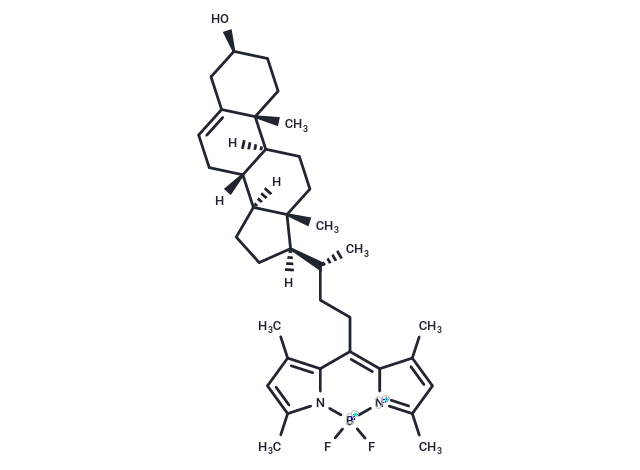
BODIPY-Cholesterol
CAS No. 878557-19-8
BODIPY-Cholesterol( —— )
Catalog No. M35243 CAS No. 878557-19-8
BODIPY-Cholesterol (TF-Chol) is a cholesterol analog with a fluorescent BODIPY motif and cellular permeability, and is a novel BODIPY cholesterol probe.
Purity : >98% (HPLC)
 COA
Datasheet
HNMR
HPLC
MSDS
Handing Instructions
COA
Datasheet
HNMR
HPLC
MSDS
Handing Instructions
| Size | Price / USD | Stock | Quantity |
| 2MG | 454 | Get Quote |


|
| 100MG | Get Quote | Get Quote |
|
| 200MG | Get Quote | Get Quote |
|
| 500MG | Get Quote | Get Quote |
|
| 1G | Get Quote | Get Quote |
|
Biological Information
-
Product NameBODIPY-Cholesterol
-
NoteResearch use only, not for human use.
-
Brief DescriptionBODIPY-Cholesterol (TF-Chol) is a cholesterol analog with a fluorescent BODIPY motif and cellular permeability, and is a novel BODIPY cholesterol probe.
-
DescriptionBODIPY-cholesterol is an intrinsically lipophilic, and cell-permeable analog of cholesterol with a fluorescent BODIPY group. BODIPY-cholesterol can be used to monitor sterol uptake and inter-organelle sterol flux in cells. (Excitation/Emission: 480/508 nm).
-
In VitroBODIPY-cholesterol assayTo prepare a stock solution of BODIPY-cholesterol for this assay, the analogue is reconstituted in DMSO to a stock concentration of 1-10 μM.Cells diluted with PBS (or other buffers) are washed (300×g, 10 min) to remove excess diluent and the loose pellet resuspended with vehicle media to a proper concentration.Cell suspensions are labeled with BODIPY-cholesterol (final concentration of 0.5-5 μM), mixed thoroughly and incubated for 10 -20 mins at 37 °C.The cells are diluted with each of the capacitation media conditions as outlined in Incubation media to a final concentration and incubated for 2 h prior to flow cytometric assessment.
-
In Vivo——
-
Synonyms——
-
PathwayOthers
-
TargetOther Targets
-
RecptorOthers
-
Research Area——
-
Indication——
Chemical Information
-
CAS Number878557-19-8
-
Formula Weight576.61
-
Molecular FormulaC36H51BF2N2O
-
Purity>98% (HPLC)
-
SolubilityIn Vitro:?DMSO : 1 mg/mL (1.73 mM) H2O : < 0.1 mg/mL (insoluble)
-
SMILES[H][C@@]1(CC[C@@]2([H])[C@]3([H])CC=C4C[C@@H](O)CC[C@]4(C)[C@@]3([H])CC[C@]12C)[C@H](C)CCC1=C2C(C)=CC(C)=[N+]2[B-](F)(F)n2c(C)cc(C)c12
-
Chemical Name——
Shipping & Storage Information
-
Storage(-20℃)
-
ShippingWith Ice Pack
-
Stability≥ 2 years
Reference
1. Daniel Wüstner, et al.Potential of BODIPY-cholesterol for analysis of cholesterol transport and diffusion in living cells. Chem Phys Lipids. 2016 Jan;194:12-28.?
molnova catalog



related products
-
H-DL-Gly-OBzl HCl
Compound Fr13877 is a useful organic compound for research related to life sciences.
-
L-Aspartic Acid 4-Be...
L-Aspartic Acid 4-Benzyl Ester is a chemical compound.
-
cis-Resveratrol
cis-Resveratrol exhibits signifcant antiviral activity. cis-Resveratrol inhibits enteroviruses with IC50s of 12.2 μM and 37.6 μM for coxsackievirus B3 (CVB3) and enterovirus 71 (EV71), respectively.
