


 Cart
Cart
 sales@molnova.com



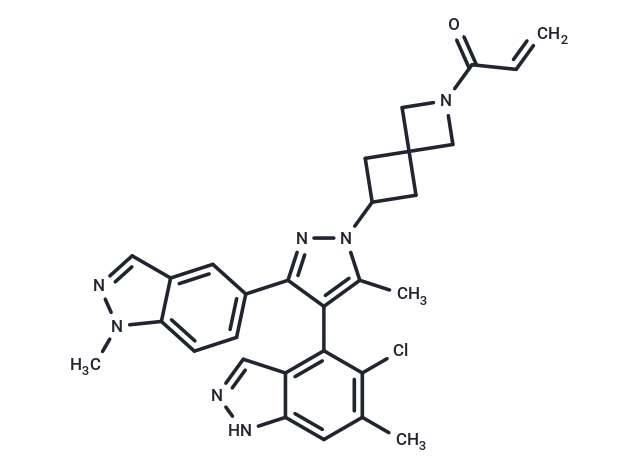
Opnurasib
CAS No. 2653994-08-0
Opnurasib( —— )
Catalog No. M35198 CAS No. 2653994-08-0
Opnurasib (JDQ-443) is an orally available and selective and potent covalent KRAS G12C inhibitor with antitumor activity for the study of advanced non-small cell lung cancer.
Purity : >98% (HPLC)
 COA
Datasheet
HNMR
HPLC
MSDS
Handing Instructions
COA
Datasheet
HNMR
HPLC
MSDS
Handing Instructions
| Size | Price / USD | Stock | Quantity |
| 1 mL x 10 mM in DMSO | 407 | In Stock |


|
| 5MG | 353 | In Stock |
|
| 10MG | 527 | In Stock |
|
| 25MG | 848 | In Stock |
|
| 100MG | Get Quote | In Stock |
|
| 200MG | Get Quote | In Stock |
|
| 500MG | Get Quote | In Stock |
|
| 1G | Get Quote | In Stock |
|
Biological Information
-
Product NameOpnurasib
-
NoteResearch use only, not for human use.
-
Brief DescriptionOpnurasib (JDQ-443) is an orally available and selective and potent covalent KRAS G12C inhibitor with antitumor activity for the study of advanced non-small cell lung cancer.
-
DescriptionOpnurasib (JDQ-443) (NVP-JDQ443) is an orally active, potent, selective, and covalent KRAS G12C inhibitor (extracted from patent WO2021120890A1). Opnurasib shows antitumor activity.
-
In VitroOpnurasib (NVP-JDQ443) traps the GDP-bound inactive conformation of KRAS.?Opnurasib promotes dose-dependent reductions of phosphorylated ERK (pERK) levels and the proliferation of the KRASG12C-mutated cell lines NCI-H358 and NCI-H2122, with IC50 values of 0.018 and 0.063 μM, respectively.?Opnurasib covalently and selectively binds and inhibits GDP-bound KRASG12C with low reversible binding affinity to the RAS switch II pocket, and also inhibits proliferation of KRASG12C-mutated and KRAS G12C/H95, G12C/R68S, and G12C/Y96 double-mutant cell lines.Western Blot Analysis Cell Line:Ba/F3 cells Concentration:0, 0.3, 1 μM Incubation Time:30 min, 4 h Result:Inhibited signaling (pERK) and proliferation of the KRAS G12C/H95 double mutants G12C/H95R and G12C/H95Q.
-
In VivoOpnurasib (10-100 mg/kg, Orally, daily for 14 days) shows antitumor activity in KRAS G12C-mutated CDX models. Opnurasib (Orally, 100 mg/kg, daily (JDQ443) + 7.5 mg/kg, twice daily (TNO155), for 36 days) shows greater cell growth inhibition or cell killing compared with single-agent JDQ443 when combined with TNO155. Opnurasib generates categorical antitumor responses in PDX models of NSCLC and colorectal tumors that are improved by combination treatment with other agents.Animal Model:KRAS G12C tumor-bearing nude mice (MIA PaCa-2 (PDAC); NCIH2122, LU99, HCC44, NCI-H2030 (NSCLC); and KYSE410 (esophageal cancer))Dosage:10, 30, 100 mg/kg Administration:Orally, daily for 14 days Result:Inhibited the growth of all models in a dose-dependent manner.Animal Model:Three KRAS G12C-mutated CDX models (LU99, NCI-H2030, and KYSE410) Dosage:100 mg/kg (JDQ443) + 7.5 mg/kg (TNO155) Administration: Orally, daily (JDQ443) or twice daily (TNO155), for 36 days Result:Combined with TNO155, showed either greater tumor efficacy compared with each agent alone (H2030, KYSE410) or a delayed time to tumor progression (LU99).
-
Synonyms——
-
PathwayOthers
-
TargetOther Targets
-
RecptorKras
-
Research Area——
-
Indication——
Chemical Information
-
CAS Number2653994-08-0
-
Formula Weight526.03
-
Molecular FormulaC29H28ClN7O
-
Purity>98% (HPLC)
-
SolubilityIn Vitro:?DMSO : 80 mg/mL (152.08 mM; Ultrasonic )
-
SMILESCc1c(c(nn1C1CC2(C1)CN(C2)C(=O)C=C)-c1ccc2n(C)ncc2c1)-c1c(Cl)c(C)cc2[nH]ncc12
-
Chemical Name——
Shipping & Storage Information
-
Storage(-20℃)
-
ShippingWith Ice Pack
-
Stability≥ 2 years
Reference
1. LIU BO, et al. PYRAZOLYL DERIVATIVES USEFUL AS ANTI-CANCER AGENTS. Patent WO2021120890A1.
molnova catalog



related products
-
11-Deoxyisomogroside...
11-Deoxyisomogroside V is a natural product for research related to life sciences.
-
G3-C12 TFA
G3-C12 TFA Salt is a specific galectin-3 binding peptide with Ksubdsub of 88 nM and shows anticancer activity.
-
Nafetolol
Nafetolol (K 5407) is a biochemical reagent that can be used to synthesize other compounds.
