


 Cart
Cart
 sales@molnova.com



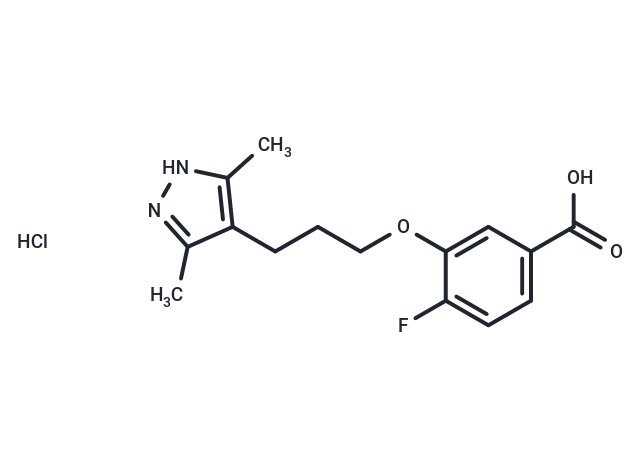
Acoramidis hydrochloride
CAS No. 2242751-53-5
Acoramidis hydrochloride( —— )
Catalog No. M35149 CAS No. 2242751-53-5
Acoramidis hydrochloride (Alxn2060 hydrochloride) is an orally active and selective kinetic stabilizer of WT and V122I- TTR (transthyretin) . Acoramidis hydrochloride is used in the study for transthyretin amyloidosis.
Purity : >98% (HPLC)
 COA
Datasheet
HNMR
HPLC
MSDS
Handing Instructions
COA
Datasheet
HNMR
HPLC
MSDS
Handing Instructions
| Size | Price / USD | Stock | Quantity |
| 1 mL x 10 mM in DMSO | 128 | In Stock |


|
| 5MG | 117 | In Stock |
|
| 10MG | 188 | In Stock |
|
| 25MG | 312 | In Stock |
|
| 50MG | 445 | In Stock |
|
| 100MG | 709 | In Stock |
|
| 200MG | 918 | In Stock |
|
| 500MG | Get Quote | In Stock |
|
| 1G | Get Quote | In Stock |
|
Biological Information
-
Product NameAcoramidis hydrochloride
-
NoteResearch use only, not for human use.
-
Brief DescriptionAcoramidis hydrochloride (Alxn2060 hydrochloride) is an orally active and selective kinetic stabilizer of WT and V122I- TTR (transthyretin) . Acoramidis hydrochloride is used in the study for transthyretin amyloidosis.
-
DescriptionAcoramidis (AG10) hydrochloride is an orally active and selective kinetic stabilizer of WT and V122I-TTR (transthyretin). Acoramidis (AG10) hydrochloride is used in the study for transthyretin amyloidosis.
-
In VitroWestern Blot Analysis.Cell Line:Human serum (TTR ~5 μM).Concentration:0.1 and 10 μM.Incubation Time:72 h.Result:Was significantly more effective than tafamidis in stabilizing TTR.The concentration of AG10 to 10 μM resulted in stabilization of almost all of TTR in serum.
-
In VivoAnimal Model:Wistar rats.Dosage:50 mg/kg/d (Toxicity Analysis).Administration:Oral gavage, daily for 28 d.Result:Showed the plasma Cmax of ~40 μM and histopathological evaluation of liver, kidney, heart, spleen, thymus, and lung showed no signs of pathologic processes in the AG10-treated animals
-
Synonyms——
-
PathwayOthers
-
TargetOther Targets
-
RecptorOthers
-
Research Area——
-
Indication——
Chemical Information
-
CAS Number2242751-53-5
-
Formula Weight328.77
-
Molecular FormulaC15H18ClFN2O3
-
Purity>98% (HPLC)
-
SolubilityIn Vitro:?DMSO : 62.5 mg/mL (190.10 mM; Ultrasonic ) H2O : < 0.1 mg/mL (insoluble)
-
SMILESCl.Cc1n[nH]c(C)c1CCCOc1cc(ccc1F)C(O)=O
-
Chemical Name——
Shipping & Storage Information
-
Storage(-20℃)
-
ShippingWith Ice Pack
-
Stability≥ 2 years
Reference
1. Sravan C Penchala, et al. AG10 inhibits amyloidogenesis and cellular toxicity of the familial amyloid cardiomyopathy-associated V122I transthyretin. Proc Natl Acad Sci U S A. 2013 Jun 11;110(24):9992-7.?
molnova catalog



related products
-
DCLK1-IN-1
DCLK1-IN-1 is a selective and in vivo-compatible chemical probe of the DCLK1 kinase domain .
-
H-Arg-Gly-Tyr-Ala-Le...
H-Arg-Gly-Tyr-Ala-Leu-Gly-OH is a competitive and CAMP dependent protein kinase inhibitor.
-
Aesculitannin B
Aesculitannin B
