


 Cart
Cart
 sales@molnova.com



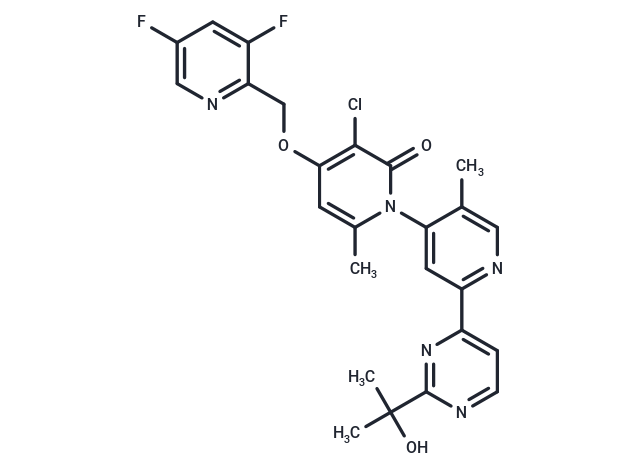
Zunsemetinib
CAS No. 1640282-42-3
Zunsemetinib( —— )
Catalog No. M35094 CAS No. 1640282-42-3
Zunsemetinib (ATI-450) is an orally active and selective inhibitor of the p38α mitogen-activated protein kinase-activated protein kinase 2 (MK2) pathway.
Purity : >98% (HPLC)
 COA
Datasheet
HNMR
HPLC
MSDS
Handing Instructions
COA
Datasheet
HNMR
HPLC
MSDS
Handing Instructions
| Size | Price / USD | Stock | Quantity |
| 1 mL x 10 mM in DMSO | 756 | In Stock |


|
| 5MG | 432 | In Stock |
|
| 10MG | 629 | In Stock |
|
| 25MG | 1254 | In Stock |
|
| 50MG | 1851 | In Stock |
|
| 100MG | Get Quote | In Stock |
|
| 200MG | Get Quote | In Stock |
|
| 500MG | Get Quote | In Stock |
|
| 1G | Get Quote | In Stock |
|
Biological Information
-
Product NameZunsemetinib
-
NoteResearch use only, not for human use.
-
Brief DescriptionZunsemetinib (ATI-450) is an orally active and selective inhibitor of the p38α mitogen-activated protein kinase-activated protein kinase 2 (MK2) pathway.
-
DescriptionZunsemetinib (CDD-450) is an orally active and selective p38α mitogen-activated protein kinase-activated protein kinase 2 (MK2) pathway inhibitor.Zunsemetinib can be used for the research of immuno-inflammatory diseases.
-
In VitroZunsemetinib (1 and 10 μM; 1 hour; WT and NOM ID BMMs) has no effect on NLRP3 expression, but decreases IL-1β expression by promoting IL-1β mRNA degradation.Zunsemetinib (0.4 nM~1 μM; 16 hours; PBMC) reduces IL-1β secretion and promotes IL-1β mRNA instability.Zunsemetinib selectively blocks p38α MAPK activation of the proinflammatory kinase MK2 while sparing p38α activation of other effectors such as PRAK and ATF2. Zunsemetinib inhibits in vitro osteoclast formation induced by RANKL.RT-PCR Cell Line:WT and NOM ID BMMs Concentration:1 and 10 μM Incubation Time:1 hour Result:Had no effect on NLRP3 expression, but decreased IL-1β expression by promoting IL-1β mRNA degradation.
-
In VivoZunsemetinib (1,000 ppm; p.o.) blocks LPS-induced TNF-α expression persisted for up to 4 weeks after dosing.Zunsemetinib (10 and 20 mg/kg; p.o.) increases bone density.Zunsemetinib prevents osteopenia in NOM IDc mice through inhibition of osteoclastogenesis.Animal Model:8-week-old WT female mice Dosage:1,000 ppm Administration:P.o.Result:Blocked LPS-induced TNF-α expression persisted for up to 4 weeks after dosing.Animal Model:Rats Dosage:10 and 20 mg/kg Administration:P.o.Result:Increased bone density.
-
Synonyms——
-
PathwayMAPK/ERK Signaling
-
Targetp38 MAPK
-
RecptorMAPK
-
Research Area——
-
Indication——
Chemical Information
-
CAS Number1640282-42-3
-
Formula Weight513.92
-
Molecular FormulaC25H22ClF2N5O3
-
Purity>98% (HPLC)
-
SolubilityIn Vitro:?DMSO : 100 mg/mL (194.58 mM; Ultrasonic )
-
SMILESCc1cnc(cc1-n1c(C)cc(OCc2ncc(F)cc2F)c(Cl)c1=O)-c1ccnc(n1)C(C)(C)O
-
Chemical Name——
Shipping & Storage Information
-
Storage(-20℃)
-
ShippingWith Ice Pack
-
Stability≥ 2 years
Reference



-
PAF (C16)
PAF (C16) is a potent MAPK and MEK/ERK activator that induces increased vascular permeability. PAF (C16) (PAF (C16)) is a platelet-activating factor, a phospholipid-derived mediator and a ligand for PAF G protein-coupled receptor (PAFR). PAF (C16) has shown anti-apoptotic and anti-inflammatory activity in vitro, inhibiting Caspase-dependent apoptosis by interacting with its receptor (PAF-R) to perform cell signaling.
-
DAMGO
DAMGO is an opioid receptor agonist with the ability to affect the locomotive activity in rodents. Possible analgesic agent due to μ-opiod receptor interaction.
-
Gossypetin
Gossypetin, a hexahydroxylated flavonoid extractable from Rhodiola rosea Linn. is a potent MKK3 and MKK6 inhibitor that strongly attenuates the MKK3/6-p38 signaling pathway.
