


 Cart
Cart
 sales@molnova.com



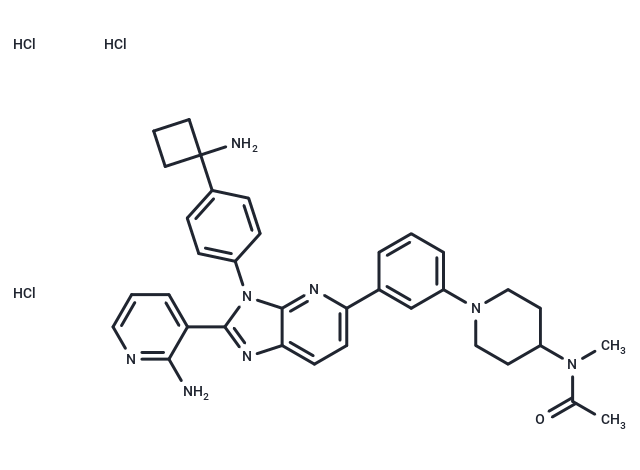
Vevorisertib trihydrochloride
CAS No. 1416775-08-0
Vevorisertib trihydrochloride( —— )
Catalog No. M35073 CAS No. 1416775-08-0
Vevorisertib trihydrochloride (ARQ 751 trihydrochloride) is a selective and potent inhibitor of pan-AKT and AKT1-E17K mutations, inhibiting AKT1, AKT2 and AKT3.
Purity : >98% (HPLC)
 COA
Datasheet
HNMR
HPLC
MSDS
Handing Instructions
COA
Datasheet
HNMR
HPLC
MSDS
Handing Instructions
| Size | Price / USD | Stock | Quantity |
| 1 mL x 10 mM in DMSO | 212 | In Stock |


|
| 5MG | 138 | In Stock |
|
| 10MG | 221 | In Stock |
|
| 25MG | 377 | In Stock |
|
| 50MG | 541 | In Stock |
|
| 100MG | 724 | In Stock |
|
| 200MG | Get Quote | In Stock |
|
| 500MG | Get Quote | In Stock |
|
| 1G | Get Quote | In Stock |
|
Biological Information
-
Product NameVevorisertib trihydrochloride
-
NoteResearch use only, not for human use.
-
Brief DescriptionVevorisertib trihydrochloride (ARQ 751 trihydrochloride) is a selective and potent inhibitor of pan-AKT and AKT1-E17K mutations, inhibiting AKT1, AKT2 and AKT3.
-
DescriptionVevorisertib (ARQ 751) trihydrochloride is a selective, allosteric, pan-AKT and AKT1-E17K mutant inhibitors. Vevorisertib trihydrochloride potently inhibit phosphorylation of AKT. Vevorisertib trihydrochloride has Kd values of 1.2 nM and 8.6 nM for AKT1 and AKT1-E17K, respectively. Vevorisertib trihydrochloride has IC50 values of 0.55, 0.81, and 1.3 nM for AKT1, AKT2, and AKT3, respectively. Vevorisertib trihydrochloride can be used for the research of cancer.
-
In VitroVevorisertib trihydrochloride (0, 12, 33, 111, 333, 1000 nM, 2 hours) inhibits phosphorylation of AKT1-E17K.Vevorisertib trihydrochloride (1 μM for 2 hours; NIH 3T3 cells are transfected with either pcDNAAKT-WT-GFP or pcDNA-E17K-GFP) inhibits plasma membrane translocation of AKT-WT and AKT1-E17K irrespective of the presence of growth factors.Vevorisertib trihydrochloride (5 μM) exhibites 57% inhibition of full-length AKT1.Vevorisertib trihydrochloride (0, 0.012, 0.037, 0.11, 0.33, 1 μM; 2 hours) shows a dose-dependent effect on mTORC1 and AKT direct substrates including PRAS40, GSK3β, FOXO, BAD, and AS160 in cancer cell lines.Vevorisertib trihydrochloride has anti-proliferative effect on esophageal, breast, and head and neck cancer cells (GI50 < 1 μM).Vevorisertib trihydrochloride exhibits strong anti-proliferative activity in PIK3CA mutant cell lines.Vevorisertib trihydrochloride (MK-4440)/imatinib mesylate (IM) combination shows cell cycle arrest, and increases cell death of gastrointestinal stromal tumor (GIST) cells.Western Blot AnalysisCell Line:293T cells (transiently transfected with pcDNA-E17K-GFP)Concentration:0, 12, 33, 111, 333, 1000 nM Incubation Time:2 hours Result:Inhibited phosphorylation of AKT1-E17K.Western Blot Analysis Cell Line:Cancer cell lines: MDA-MB 453 (PIK3CAH1047R; Her2 amp), NCI-H1650 (PTEN null), KU-19-19 (AKT1-E17K&E49K; NRas Q61R) Concentration:0, 0.012, 0.037, 0.11, 0.33, 1 μM Incubation Time:2 hours Result: Showed a dose-dependent effect on mTORC1 and AKT direct substrates including PRAS40, GSK3β, FOXO, BAD, and AS160.
-
In VivoVevorisertib trihydrochloride (25, 50 and 75 mg/kg; p.o.; 5 days dosing followed by a 4 day dosing holiday for 20 days) shows potent tumor growth inhibition of 68, 78 and 98%, respectively.Vevorisertib trihydrochloride (5, 10, 20, 40, 80, and 120 mg/kg; p.o. daily for ten days) shows tumor growth inhibition of 29, 33, 50, 73, 83, and 92%, respectively.Vevorisertib trihydrochloride reachs Cmax plasma concentrations of ≥2 μM.Vevorisertib trihydrochloride is generally well-tolerated at dose levels up to 120 mg/kg.Vevorisertib trihydrochloride (MK-4440)/IM combination shows superior efficacy in an IM-sensitive preclinical model of GIST compared with either single agent.Animal Model:Endometrial PDX mouse xenograft models (AKT1-E17K mutation tumor fragments subcutaneously implanted in athymic nude mice; tumor volume of approximately 200 mm3) Dosage:25, 50 and 75 mg/kg Administration:p.o.; 5 days dosing followed by a 4 day dosing holiday for 20 days Result:Showed potent tumor growth inhibition of 68, 78 and 98%, respectively.Animal Model:AN3CA mouse xenograft models (female NCr nu/nu mice with 250 mm3 tumors size) Dosage:5, 10, 20, 40, 80, and 120 mg/kg Administration:p.o.; daily for ten days Result:Showed tumor growth inhibition of 29, 33, 50, 73, 83, and 92%, respectively.
-
Synonyms——
-
PathwayCytoskeleton/Cell Adhesion Molecules
-
TargetAkt
-
RecptorAkt
-
Research Area——
-
Indication——
Chemical Information
-
CAS Number1416775-08-0
-
Formula Weight696.12
-
Molecular FormulaC35H41Cl3N8O
-
Purity>98% (HPLC)
-
SolubilityIn Vitro:?DMSO : 150 mg/mL (215.48 mM; Ultrasonic )H2O : 25 mg/mL (35.91 mM; Ultrasonic (<60°C))
-
SMILESCl.Cl.Cl.CN(C1CCN(CC1)c1cccc(c1)-c1ccc2nc(-c3cccnc3N)n(-c3ccc(cc3)C3(N)CCC3)c2n1)C(C)=O
-
Chemical Name——
Shipping & Storage Information
-
Storage(-20℃)
-
ShippingWith Ice Pack
-
Stability≥ 2 years
Reference



-
Chromeceptin
Chromeceptin is an inhibitor of the IGF signaling pathway, decreases the numbers of tumorsphere, and inhibits the AKT/mTOR pathway.
-
YS-67
YS-67 is an orally available, selective and potent EGFR inhibitor with antitumor activity, inhibits p-EGFR and p-AKT, and inhibits the proliferation of A549, PC-9, and A431 cells.
-
Arnicolide D
Arnicolide D is a sesquiterpene lactone. Arnicolide D isolates from Centipeda minima. Arnicolide D modulates the cell cycle, activates the caspase signaling pathway and inhibits the PI3K/AKT/mTOR and STAT3 signaling pathways. Arnicolide D inhibits Nasopharyngeal carcinoma (NPC) cell viability in a concentration- and time-dependent manner. Arnicolide D exerts strong cytotoxic activity on the human colon carcinoma HT-29 cell line.
