


 Cart
Cart
 sales@molnova.com



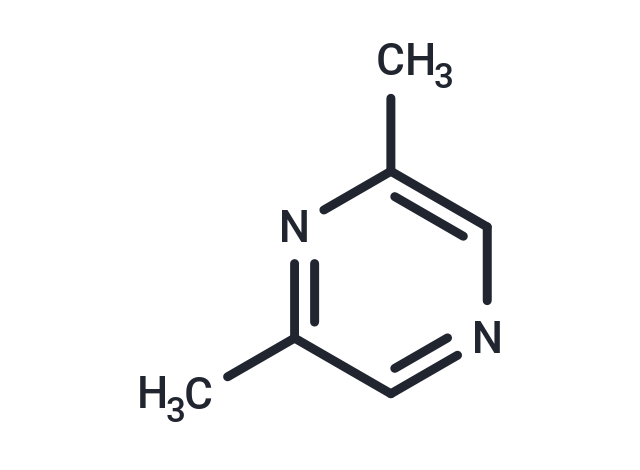
2,6-Dimethylpyrazine
CAS No. 108-50-9
2,6-Dimethylpyrazine( —— )
Catalog No. M35045 CAS No. 108-50-9
2,6-Dimethylpyrazine is an indispensable flavor additive in the food industry and an important substrate for the production of hypoglycemic and antilipolytic compounds.
Purity : >98% (HPLC)
 COA
Datasheet
HNMR
HPLC
MSDS
Handing Instructions
COA
Datasheet
HNMR
HPLC
MSDS
Handing Instructions
| Size | Price / USD | Stock | Quantity |
| 1 mL x 10 mM in DMSO | 28 | In Stock |


|
| 100MG | Get Quote | In Stock |
|
| 200MG | Get Quote | In Stock |
|
| 500MG | Get Quote | In Stock |
|
| 1G | 27 | In Stock |
|
Biological Information
-
Product Name2,6-Dimethylpyrazine
-
NoteResearch use only, not for human use.
-
Brief Description2,6-Dimethylpyrazine is an indispensable flavor additive in the food industry and an important substrate for the production of hypoglycemic and antilipolytic compounds.
-
Description2,6-Dimethylpyrazine is a key aroma compound in Boletus edulis.
-
In Vitro——
-
In Vivo——
-
Synonyms——
-
PathwayOthers
-
TargetOther Targets
-
RecptorOthers
-
Research Area——
-
Indication——
Chemical Information
-
CAS Number108-50-9
-
Formula Weight108.14
-
Molecular FormulaC6H8N2
-
Purity>98% (HPLC)
-
SolubilityIn Vitro:?DMSO : 100 mg/mL (924.73 mM; Ultrasonic )
-
SMILESCc1cncc(C)n1
-
Chemical Name——
Shipping & Storage Information
-
Storage(-20℃)
-
ShippingWith Ice Pack
-
Stability≥ 2 years
Reference
1. Zhuang J, et al. Comparative flavor profile analysis of four different varieties of Boletus mushrooms by instrumental and sensory techniques. Food Res Int. 2020;136:109485.?
molnova catalog



related products
-
Dihydroparadol
The herbs of Zingiber officinale.
-
Etofylline
Etofylline is used as a Bronchodilator Agent.
-
8-(4-iodophenyl)-1,3...
8-(4-iodophenyl)-1,3,5,7-tetramethyl BODIPY is a novel BODIPY fluorescent dye for the treatment of cytotoxicity.
