


 Cart
Cart
 sales@molnova.com



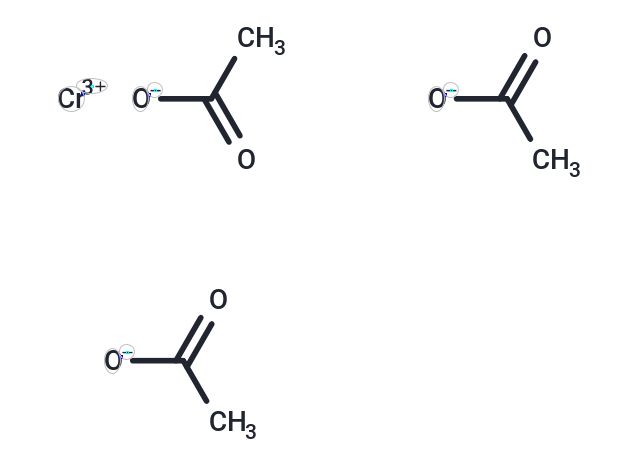
Chromium(III) acetate
CAS No. 1066-30-4
Chromium(III) acetate( —— )
Catalog No. M35041 CAS No. 1066-30-4
Chromium(III) acetate (Chromium acetate) is a small molecule ionic crosslinker that is used as a feedstock for the synthesis of other compounds.
Purity : >98% (HPLC)
 COA
Datasheet
HNMR
HPLC
MSDS
Handing Instructions
COA
Datasheet
HNMR
HPLC
MSDS
Handing Instructions
| Size | Price / USD | Stock | Quantity |
| 1 mL x 10 mM in DMSO | 37 | In Stock |


|
| 100MG | Get Quote | In Stock |
|
| 200MG | Get Quote | In Stock |
|
| 500MG | Get Quote | In Stock |
|
| 1G | Get Quote | In Stock |
|
Biological Information
-
Product NameChromium(III) acetate
-
NoteResearch use only, not for human use.
-
Brief DescriptionChromium(III) acetate (Chromium acetate) is a small molecule ionic crosslinker that is used as a feedstock for the synthesis of other compounds.
-
DescriptionChromium(III) acetate (Chromic acetate) is an ionic crosslinker.
-
In Vitro——
-
In Vivo——
-
Synonyms——
-
PathwayOthers
-
TargetOther Targets
-
RecptorOthers
-
Research Area——
-
Indication——
Chemical Information
-
CAS Number1066-30-4
-
Formula Weight76.37
-
Molecular FormulaC2H3O2.1/3Cr
-
Purity>98% (HPLC)
-
SolubilityIn Vitro:?DMSO : 14.29 mg/mL (62.37 mM; Ultrasonic )
-
SMILESO=C(C)[O-].[Cr+3] 1/3 Chromium
-
Chemical Name——
Shipping & Storage Information
-
Storage(-20℃)
-
ShippingWith Ice Pack
-
Stability≥ 2 years
Reference
1. Mahsa Baghban Salehi, et al. Rheological and transport properties of sulfonated polyacrylamide hydrogels for water shutoff in porous media. Polym. Adv. Technol. 2014, 25 396-405.
molnova catalog



related products
-
Eα (52–68)
Eα (52–68)
-
Moreollic acid
Moreollic acid has moderate antibacterial activity against methicillin-resistant Staphylococcus aureus with an MIC of 25 microg/ml.
-
Kelampayoside A
Kelampayoside A is a natural product from Callicarpa peii.
