


 Cart
Cart
 sales@molnova.com



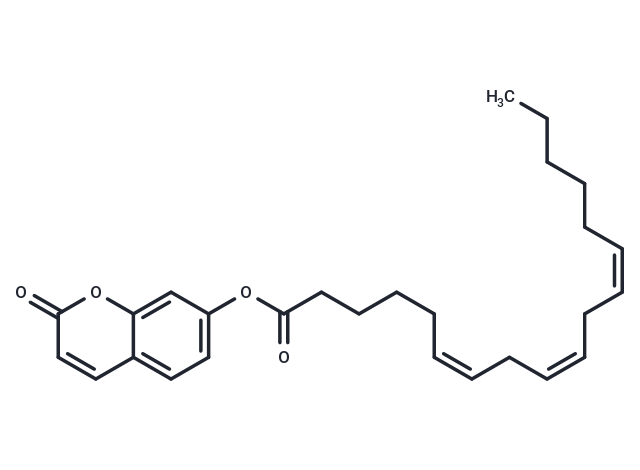
7-hydroxycoumarinyl-γ-Linolenate
CAS No. 161180-12-7
7-hydroxycoumarinyl-γ-Linolenate( —— )
Catalog No. M34987 CAS No. 161180-12-7
7-hydroxycoumarinyl-γ-Linolenate is a γ-linolenic acid ester of 7-hydroxycoumarin (umbelliferone) that behaves as a substrate for cPLA2. Hydrolysis of 7-hydroxycoumarinyl-γ-linolenate by phospholipase results in the release of the fluorescent compound 7-hydroxycoumarin which can be monitored spectrophotometrically (excitation at 335 nm, emission at 450 nm).
Purity : >98% (HPLC)
 COA
Datasheet
HNMR
HPLC
MSDS
Handing Instructions
COA
Datasheet
HNMR
HPLC
MSDS
Handing Instructions
| Size | Price / USD | Stock | Quantity |
| 5MG | 112 | In Stock |


|
| 25MG | 459 | In Stock |
|
| 50MG | 818 | In Stock |
|
| 100MG | Get Quote | In Stock |
|
| 200MG | Get Quote | In Stock |
|
| 500MG | Get Quote | In Stock |
|
| 1G | Get Quote | In Stock |
|
Biological Information
-
Product Name7-hydroxycoumarinyl-γ-Linolenate
-
NoteResearch use only, not for human use.
-
Brief Description7-hydroxycoumarinyl-γ-Linolenate is a γ-linolenic acid ester of 7-hydroxycoumarin (umbelliferone) that behaves as a substrate for cPLA2. Hydrolysis of 7-hydroxycoumarinyl-γ-linolenate by phospholipase results in the release of the fluorescent compound 7-hydroxycoumarin which can be monitored spectrophotometrically (excitation at 335 nm, emission at 450 nm).
-
Description7-Hydroxycoumarinyl-γ-linolenate is a cytosolic phospholipase A2 (cPLA2) fluorogenic substrate. 7-Hydroxycoumarinyl-γ-linolenate can be used to monitor the enzymatic activity of cPLA2.
-
In VitroGuidelines (Following is our recommended protocol. This protocol only provides a guideline, and should be modified according to your specific needs).cPLA2α activity assay:1. Sonicate 200μL of 1,2-O-tetradecyl-sn-glycero-3-phosphocholine (DTPC)/Triton X-100 high-affinity mixed micelle solution containing 960μM Triton X-100 (HY-Y1883A), 60μM DTPC, 50μM 7-hydroxycoumarinyl-γ-linolenate, 50mM N-2-hydroxyethylpiperazine-N-2-ethane sulfonic acid buffer (pH?=7.2), 0.3mM EDTA (HY-Y0682), 1mM CaCl2 and 300mM KCl.2. Monitoring the hydrolysis of 7-hydroxycoumarinyl-γ-linolenate continuously with excitation at 360nm and emission at 460nm.3. The formation of 7-hydroxycoumarin was monitored by fluorospectrometer..
-
In Vivo——
-
Synonyms——
-
PathwayOthers
-
TargetOther Targets
-
RecptorOthers
-
Research Area——
-
Indication——
Chemical Information
-
CAS Number161180-12-7
-
Formula Weight422.56
-
Molecular FormulaC27H34O4
-
Purity>98% (HPLC)
-
Solubility——
-
SMILESO(C(CCCC/C=C\C/C=C\C/C=C\CCCCC)=O)C=1C=C2C(=CC1)C=CC(=O)O2
-
Chemical Name——
Shipping & Storage Information
-
Storage(-20℃)
-
ShippingWith Ice Pack
-
Stability≥ 2 years
Reference
1. Xiao Q, et al. Bufexamac ameliorates LPS-induced acute lung injury in mice by targeting LTA4H. Sci Rep. 2016 Apr 29;6:25298.?
molnova catalog



related products
-
CCP peptide
CCP peptide is a synthetic cyclic peptide incorporating the amino acid citrulline.
-
2-Chloro-1-(4-fluoro...
2-Chloro-1-(4-fluorobenzyl)benzimidazole is an ?inhibitor of aldose reductase (ALR2).
-
Prepro-Atrial Natriu...
Prepro-Atrial Natriuretic Factor (104-123) (human)
