


 Cart
Cart
 sales@molnova.com



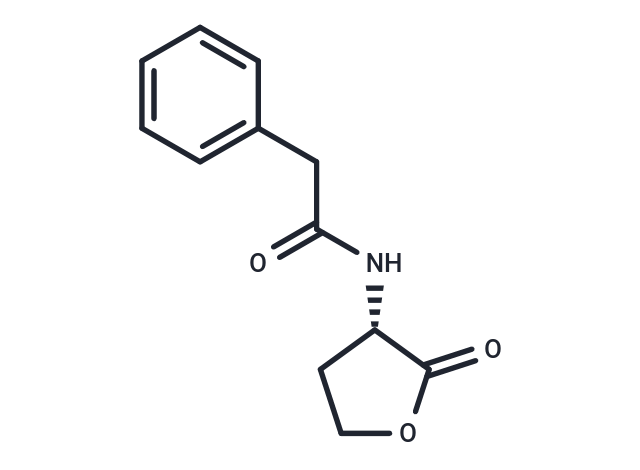
N-phenylacetyl-L-Homoserine lactone
CAS No. 55154-48-8
N-phenylacetyl-L-Homoserine lactone( —— )
Catalog No. M34981 CAS No. 55154-48-8
N-phenylacetyl-L-Homoserine lactone attenuates the group sensing of the pathogen Acinetobacter baumannii and can be used to study bacterial infections.
Purity : >98% (HPLC)
 COA
Datasheet
HNMR
HPLC
MSDS
Handing Instructions
COA
Datasheet
HNMR
HPLC
MSDS
Handing Instructions
| Size | Price / USD | Stock | Quantity |
| 5MG | 126 | In Stock |


|
| 10MG | 216 | In Stock |
|
| 25MG | 448 | In Stock |
|
| 50MG | 597 | In Stock |
|
| 100MG | 798 | In Stock |
|
| 200MG | 1079 | In Stock |
|
| 500MG | Get Quote | In Stock |
|
| 1G | Get Quote | In Stock |
|
Biological Information
-
Product NameN-phenylacetyl-L-Homoserine lactone
-
NoteResearch use only, not for human use.
-
Brief DescriptionN-phenylacetyl-L-Homoserine lactone attenuates the group sensing of the pathogen Acinetobacter baumannii and can be used to study bacterial infections.
-
DescriptionN-phenylacetyl-L-Homoserine lactone attenuates the group sensing of the pathogen Acinetobacter baumannii and can be used to study bacterial infections.
-
In Vitro——
-
In Vivo——
-
Synonyms——
-
PathwayOthers
-
TargetOther Targets
-
RecptorOthers
-
Research Area——
-
Indication——
Chemical Information
-
CAS Number55154-48-8
-
Formula Weight219.24
-
Molecular FormulaC12H13NO3
-
Purity>98% (HPLC)
-
Solubility——
-
SMILESN(C(CC1=CC=CC=C1)=O)[C@@H]2C(=O)OCC2
-
Chemical Name——
Shipping & Storage Information
-
Storage(-20℃)
-
ShippingWith Ice Pack
-
Stability≥ 2 years
Reference
molnova catalog



related products
-
Glofitamab
Glofitamab (RO7082859) is a novel bivalent antibody directed against CD20-binding T cells.Glofitamab promotes T cell proliferation and activation and tumor cell killing by binding to CD20 on malignant cells.
-
CT-2584
CT-2584 is an anticancer agent that inhibits phospholipid signaling and kills tumor cells through the production of reactive oxygen intermediates.
-
N-Valyltryptophan
N-Valyltryptophan is an incomplete breakdown product of protein catabolism or protein digestion.
