


 Cart
Cart
 sales@molnova.com



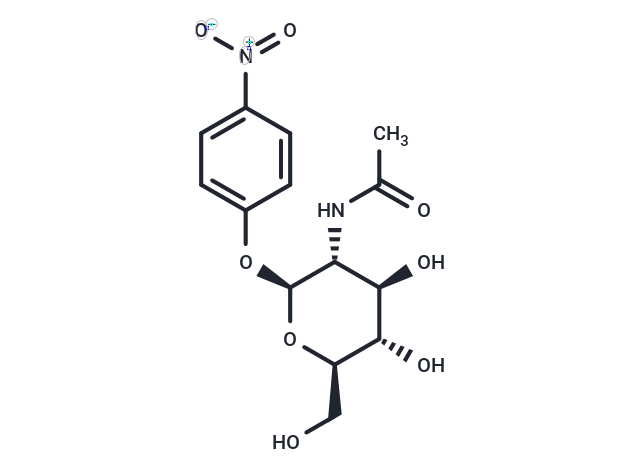
GLcNAc1-b-PNP
CAS No. 3459-18-5
GLcNAc1-b-PNP( —— )
Catalog No. M34961 CAS No. 3459-18-5
GLcNAc1-b-PNP is a chromogenic substrate for N-acetyl-β-glucosaminidase and can be used to quantify the activity of N-acetyl-β-D-glucosaminidase in human serum and urine.
Purity : >98% (HPLC)
 COA
Datasheet
HNMR
HPLC
MSDS
Handing Instructions
COA
Datasheet
HNMR
HPLC
MSDS
Handing Instructions
| Size | Price / USD | Stock | Quantity |
| 100MG | Get Quote | In Stock |


|
| 200MG | 37 | In Stock |
|
| 500MG | 60 | In Stock |
|
| 1G | Get Quote | In Stock |
|
Biological Information
-
Product NameGLcNAc1-b-PNP
-
NoteResearch use only, not for human use.
-
Brief DescriptionGLcNAc1-b-PNP is a chromogenic substrate for N-acetyl-β-glucosaminidase and can be used to quantify the activity of N-acetyl-β-D-glucosaminidase in human serum and urine.
-
Description4-Nitrophenyl-N-acetyl-β-D-glucosaminide, an artificial substrate of N-acetyl-beta-D-hexosaminidase (NAGase), can be used in rapid and accurate rate assay for N-acetyl-beta-D-hexosaminidase.
-
In Vitro——
-
In Vivo——
-
Synonyms——
-
PathwayOthers
-
TargetOther Targets
-
RecptorOthers
-
Research Area——
-
Indication——
Chemical Information
-
CAS Number3459-18-5
-
Formula Weight342.3
-
Molecular FormulaC14H18N2O8
-
Purity>98% (HPLC)
-
SolubilityIn Vitro:?DMSO : 100 mg/mL (292.14 mM; Ultrasonic )H2O : 2 mg/mL (5.84 mM; Ultrasonic (<60°C))
-
SMILESCC(=O)N[C@@H]1[C@@H](O)[C@H](O)[C@@H](CO)O[C@H]1Oc1ccc(cc1)[N+]([O-])=O
-
Chemical Name——
Shipping & Storage Information
-
Storage(-20℃)
-
ShippingWith Ice Pack
-
Stability≥ 2 years
Reference
1. Shibata H, et, al. Rate assay of N-acetyl-beta-D-hexosaminidase with 4-nitrophenyl N-acetyl-beta-D-glucosaminide as an artificial substrate. Clin Chim Acta. 1996 Jul 15;251(1):53-64. ?
molnova catalog



related products
-
Isonormangostin
Isonormangostin is a natural product of Garcinia, Clusiaceae. Isonormangostin can be used as a reference standard.
-
Fibrinogen-Binding P...
Fibrinogen-Binding Peptide (designed by anticomplementarity hypothesis) is a presumptive peptide mimic of the vitronectin binding site on the fibrinogen receptor. Fibrinogen, a soluble plasma protein, is a cofactor in platelet activation. It is converted to fibrin in a reaction catalyzed by thrombin.
-
Protosappanin B
Protosappanin B significantly increases cell viability, inhibits cell apoptosis and up-regulates the expression of growth-associated protein 43.
