


 Cart
Cart
 sales@molnova.com



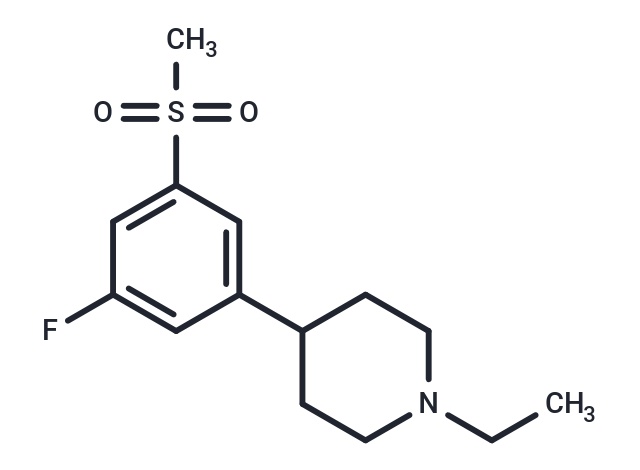
Seridopidine
CAS No. 883631-51-4
Seridopidine( —— )
Catalog No. M34708 CAS No. 883631-51-4
Seridopidine (ACR343) is a modulator of dopaminergic activity that is used as an oral therapy for schizophrenia, Parkinson's disease, and Tourette's syndrome.
Purity : >98% (HPLC)
 COA
Datasheet
HNMR
HPLC
MSDS
Handing Instructions
COA
Datasheet
HNMR
HPLC
MSDS
Handing Instructions
| Size | Price / USD | Stock | Quantity |
| 5MG | 333 | In Stock |


|
| 10MG | 504 | In Stock |
|
| 25MG | 816 | In Stock |
|
| 50MG | 1097 | In Stock |
|
| 100MG | 1479 | In Stock |
|
| 200MG | Get Quote | In Stock |
|
| 500MG | 2967 | In Stock |
|
| 1G | Get Quote | In Stock |
|
Biological Information
-
Product NameSeridopidine
-
NoteResearch use only, not for human use.
-
Brief DescriptionSeridopidine (ACR343) is a modulator of dopaminergic activity that is used as an oral therapy for schizophrenia, Parkinson's disease, and Tourette's syndrome.
-
DescriptionSeridopidine (ACR343) is a modulator of dopaminergic activity that is used as an oral therapy for schizophrenia, Parkinson's disease, and Tourette's syndrome.
-
In Vitro——
-
In Vivo——
-
Synonyms——
-
PathwayGPCR/G Protein
-
TargetDopamine Receptor
-
RecptorDopamine Receptor
-
Research Area——
-
Indication——
Chemical Information
-
CAS Number883631-51-4
-
Formula Weight285.38
-
Molecular FormulaC14H20FNO2S
-
Purity>98% (HPLC)
-
Solubility——
-
SMILESS(C)(=O)(=O)C=1C=C(C=C(F)C1)C2CCN(CC)CC2
-
Chemical Name——
Shipping & Storage Information
-
Storage(-20℃)
-
ShippingWith Ice Pack
-
Stability≥ 2 years
Reference
molnova catalog



related products
-
Rotigotine
A non-selective agonist of the dopamine D3 receptor (Ki=0.71 nM); has 10-fold selectivity for the D3 receptor over the D2, D4, and D5 receptors and 100-fold selectivity for the D3 receptor over the D1 receptor.
-
Alizapride hydrochlo...
Alizapride hydrochloride is a dopamine receptor antagonist used for the theropy of nausea and vomiting.
-
Thiethylperazine dim...
Thiethylperazine dimaleate is an antagonist of the D2 receptor and H1 receptor.
