


 Cart
Cart
 sales@molnova.com



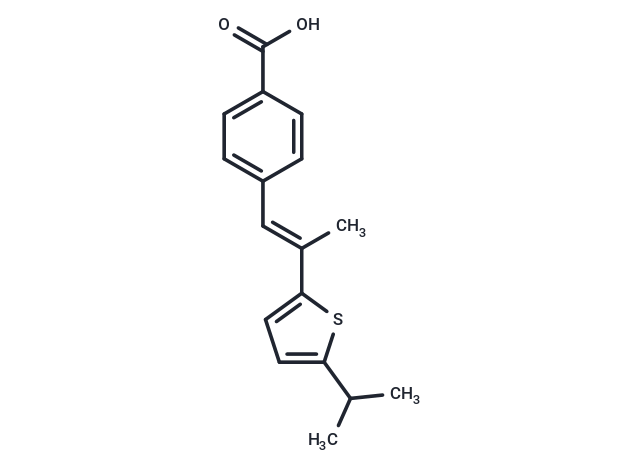
Namirotene
CAS No. 101506-83-6
Namirotene( —— )
Catalog No. M34662 CAS No. 101506-83-6
Namirotene (CBS 211A) is a protein biosynthesis inhibitor, a synthetic retinoic acid analog that is used in the study of corneal diseases, corneal ulcers and dry eye syndrome.
Purity : >98% (HPLC)
 COA
Datasheet
HNMR
HPLC
MSDS
Handing Instructions
COA
Datasheet
HNMR
HPLC
MSDS
Handing Instructions
| Size | Price / USD | Stock | Quantity |
| 5MG | 170 | In Stock |


|
| 10MG | 257 | In Stock |
|
| 25MG | 481 | In Stock |
|
| 50MG | 632 | In Stock |
|
| 100MG | 921 | In Stock |
|
| 200MG | Get Quote | In Stock |
|
| 500MG | 1841 | In Stock |
|
| 1G | Get Quote | In Stock |
|
Biological Information
-
Product NameNamirotene
-
NoteResearch use only, not for human use.
-
Brief DescriptionNamirotene (CBS 211A) is a protein biosynthesis inhibitor, a synthetic retinoic acid analog that is used in the study of corneal diseases, corneal ulcers and dry eye syndrome.
-
DescriptionNamirotene (CBS 211A) is a protein biosynthesis inhibitor, a synthetic retinoic acid analog that is used in the study of corneal diseases, corneal ulcers and dry eye syndrome.
-
In Vitro——
-
In Vivo——
-
Synonyms——
-
PathwayOthers
-
TargetOther Targets
-
RecptorOthers
-
Research Area——
-
Indication——
Chemical Information
-
CAS Number101506-83-6
-
Formula Weight286.39
-
Molecular FormulaC17H18O2S
-
Purity>98% (HPLC)
-
Solubility——
-
SMILESC(=C\C1=CC=C(C(O)=O)C=C1)(\C)/C=2SC(C(C)C)=CC2
-
Chemical Name——
Shipping & Storage Information
-
Storage(-20℃)
-
ShippingWith Ice Pack
-
Stability≥ 2 years
Reference
molnova catalog



related products
-
Osteocalcin (7-19) (...
Osteocalcin (7-19) (human) is a peptide fragment of Osteocalcin, can be used as a peptide tag.
-
Gamma-Oryzanol
Gamma Oryzanol is a natural nutrient extract isolated from rice bran oil that contains a mixture of sterols and ferulic acids.
-
Cyclo(Leu-Val)
Cyclo(Leu-Val) is a cyclic dipeptide from the fermentation broth of F8712 strain.
