


 Cart
Cart
 sales@molnova.com



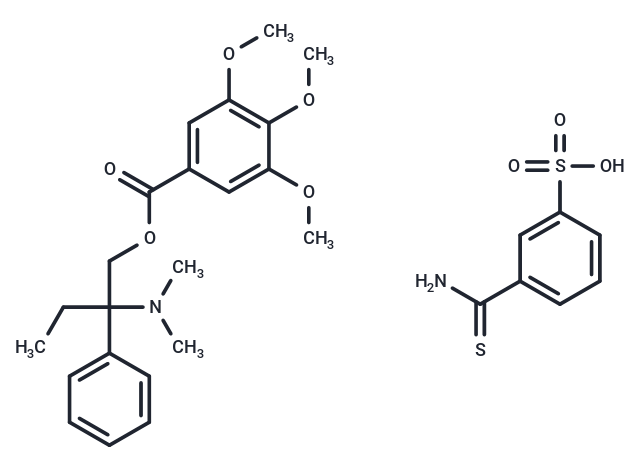
Trimebutine CTB salt
CAS No. 1456509-46-8
Trimebutine CTB salt( —— )
Catalog No. M34266 CAS No. 1456509-46-8
Trimebutine CTB salt (GIC-1001) is an opioid receptor agonist used in the study of pain.
Purity : >98% (HPLC)
 COA
Datasheet
HNMR
HPLC
MSDS
Handing Instructions
COA
Datasheet
HNMR
HPLC
MSDS
Handing Instructions
| Size | Price / USD | Stock | Quantity |
| 2MG | 246 | In Stock |


|
| 5MG | 411 | In Stock |
|
| 10MG | 562 | In Stock |
|
| 25MG | 866 | In Stock |
|
| 100MG | Get Quote | In Stock |
|
| 200MG | Get Quote | In Stock |
|
| 500MG | Get Quote | In Stock |
|
| 1G | Get Quote | In Stock |
|
Biological Information
-
Product NameTrimebutine CTB salt
-
NoteResearch use only, not for human use.
-
Brief DescriptionTrimebutine CTB salt (GIC-1001) is an opioid receptor agonist used in the study of pain.
-
DescriptionTrimebutine CTB salt (GIC-1001) is an opioid receptor agonist used in the study of pain.
-
In Vitro——
-
In Vivo——
-
Synonyms——
-
PathwayEndocrinology/Hormones
-
TargetOpioid Receptor
-
RecptorOpioid Receptor
-
Research Area——
-
Indication——
Chemical Information
-
CAS Number1456509-46-8
-
Formula Weight604.74
-
Molecular FormulaC29H36N2O8S2
-
Purity>98% (HPLC)
-
Solubility——
-
SMILESO=C(OCC(C=1C=CC=CC1)(N(C)C)CC)C2=CC(OC)=C(OC)C(OC)=C2.O=S(=O)(O)C=1C=CC=C(C1)C(=S)N
-
Chemical Name——
Shipping & Storage Information
-
Storage(-20℃)
-
ShippingWith Ice Pack
-
Stability≥ 2 years
Reference
molnova catalog



related products
-
(-)-U-50488 hydrochl...
The more active enantiomer of (±)-U-50488, a potent, selective kappa-opioid receptor agonist with no μ-opioid antagonist effects.
-
Nociceptin (1-13) am...
Nociceptin (1-13), amide is a potent agonist Opioid receptor-like1 (ORL1) receptor with a pEC50 of 7.9 for mouse vas deferens and a Ki of 0.75 nM for binding to rat forebrain membranes.
-
CTOP
Potent and selective μ opioid receptor antagonist (Ki values are 0.96 and >10,000 nM for μ and δ receptors respectively). Causes behavioral effects on central administration in vivo. Also increases K+ currents in rat locus ceruleus neurons in vitro via a μ receptor independent mechanism.
