


 Cart
Cart
 sales@molnova.com



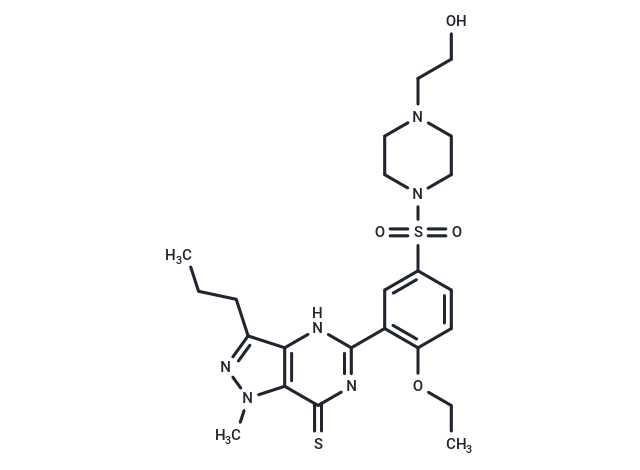
Hydroxythiohomosildenafil
CAS No. 479073-82-0
Hydroxythiohomosildenafil( —— )
Catalog No. M34082 CAS No. 479073-82-0
Hydroxythiohomosildenafil (Sulfohydroxyhomo sildenafil) is a sildenafil analog that may be used to study erectile dysfunction.
Purity : >98% (HPLC)
 COA
Datasheet
HNMR
HPLC
MSDS
Handing Instructions
COA
Datasheet
HNMR
HPLC
MSDS
Handing Instructions
| Size | Price / USD | Stock | Quantity |
| 2MG | 414 | In Stock |


|
| 5MG | 686 | In Stock |
|
| 10MG | 938 | In Stock |
|
| 25MG | 1444 | In Stock |
|
| 50MG | 1841 | In Stock |
|
| 100MG | Get Quote | In Stock |
|
| 200MG | Get Quote | In Stock |
|
| 500MG | Get Quote | In Stock |
|
| 1G | Get Quote | In Stock |
|
Biological Information
-
Product NameHydroxythiohomosildenafil
-
NoteResearch use only, not for human use.
-
Brief DescriptionHydroxythiohomosildenafil (Sulfohydroxyhomo sildenafil) is a sildenafil analog that may be used to study erectile dysfunction.
-
DescriptionHydroxythiohomosildenafil (Sulfohydroxyhomo sildenafil) is a sildenafil analog that may be used to study erectile dysfunction.
-
In Vitro——
-
In Vivo——
-
Synonyms——
-
PathwayOthers
-
TargetOther Targets
-
RecptorOthers
-
Research Area——
-
Indication——
Chemical Information
-
CAS Number479073-82-0
-
Formula Weight520.67
-
Molecular FormulaC23H32N6O4S2
-
Purity>98% (HPLC)
-
Solubility——
-
SMILESO=S(=O)(C=1C=CC(OCC)=C(C1)C2=NC(=S)C3=C(N2)C(=NN3C)CCC)N4CCN(CCO)CC4
-
Chemical Name——
Shipping & Storage Information
-
Storage(-20℃)
-
ShippingWith Ice Pack
-
Stability≥ 2 years
Reference
molnova catalog



related products
-
o-Veratraldehyde
Veratraldehyde is an organic compound that is widely used as a flavorant and odorant. The compound is structurally related to benzaldehyde.
-
Pseudolaroside A
Pseudolaroside A is a benzylisoquinoline glycoside that can be isolated from Pseudolarix kaempferi.
-
Complanatin II
Complanatin is an acylated flavonol glycoside, it can be isolated from Astragalus complanatus R. Br.
