


 Cart
Cart
 sales@molnova.com



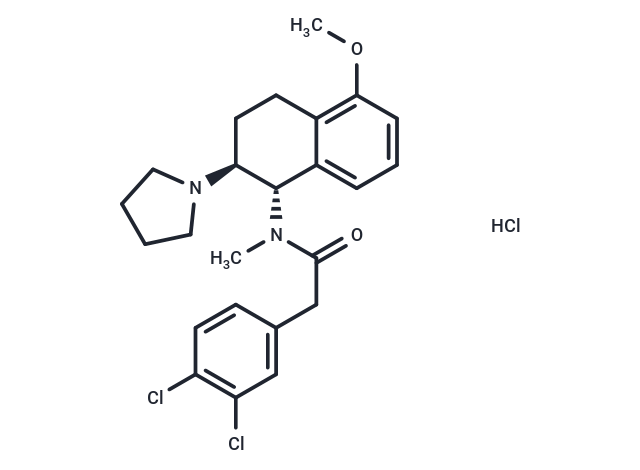
DuP 747 HCl
CAS No. 115904-74-0
DuP 747 HCl( —— )
Catalog No. M34069 CAS No. 115904-74-0
DuP 747 HCl is a selective kappa agonist with analgesic activity.DuP 747 consists of two conformations.
Purity : >98% (HPLC)
 COA
Datasheet
HNMR
HPLC
MSDS
Handing Instructions
COA
Datasheet
HNMR
HPLC
MSDS
Handing Instructions
| Size | Price / USD | Stock | Quantity |
| 5MG | 610 | In Stock |


|
| 10MG | 867 | In Stock |
|
| 25MG | 1302 | In Stock |
|
| 50MG | 1721 | In Stock |
|
| 100MG | 2325 | In Stock |
|
| 200MG | Get Quote | In Stock |
|
| 500MG | Get Quote | In Stock |
|
| 1G | Get Quote | In Stock |
|
Biological Information
-
Product NameDuP 747 HCl
-
NoteResearch use only, not for human use.
-
Brief DescriptionDuP 747 HCl is a selective kappa agonist with analgesic activity.DuP 747 consists of two conformations.
-
DescriptionDuP 747 HCl is a selective kappa agonist with analgesic activity.DuP 747 consists of two conformations.
-
In Vitro——
-
In Vivo——
-
Synonyms——
-
PathwayEndocrinology/Hormones
-
TargetOpioid Receptor
-
RecptorOpioid Receptor
-
Research Area——
-
Indication——
Chemical Information
-
CAS Number115904-74-0
-
Formula Weight483.86
-
Molecular FormulaC24H29Cl3N2O2
-
Purity>98% (HPLC)
-
Solubility——
-
SMILESN(C(CC1=CC(Cl)=C(Cl)C=C1)=O)(C)[C@H]2C=3C(=C(OC)C=CC3)CC[C@@H]2N4CCCC4.Cl
-
Chemical Name——
Shipping & Storage Information
-
Storage(-20℃)
-
ShippingWith Ice Pack
-
Stability≥ 2 years
Reference
molnova catalog



related products
-
CP-866087
CP-866087 is a novel, potent and selective mu-opioid receptor antagonist for the study of female sexual dysfunction.
-
Adrenorphin 3TFA(883...
Adrenorphin(3TFA) is an agonist of μ-opioid receptor(Ki :12 nM).
-
CTAP
Potent and selective μ opioid receptor antagonist (IC50 = 3.5 nM). Displays > 1200-fold selectivity over δ opioid and somatostatin receptors. Brain penetrant and active in vivo.
