


 Cart
Cart
 sales@molnova.com



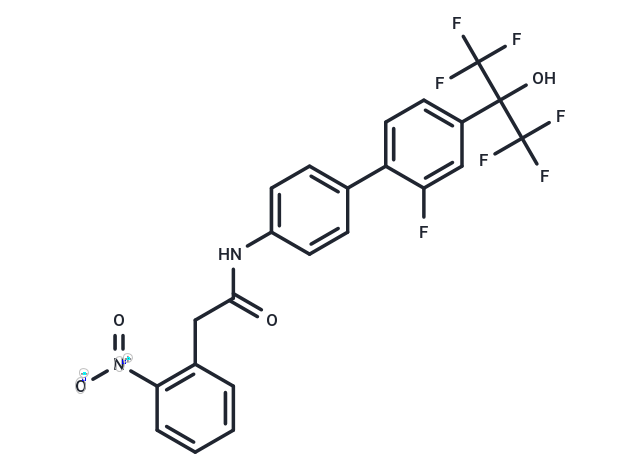
XY018
CAS No. 1873358-87-2
XY018( —— )
Catalog No. M33993 CAS No. 1873358-87-2
XY018 is an orally available, selective and highly effective ROR-γ antagonist with antitumor activity, inhibits ROR-γ activity, inhibits tumor cell growth, and can be used to study drug-resistant prostate cancer.
Purity : >98% (HPLC)
 COA
Datasheet
HNMR
HPLC
MSDS
Handing Instructions
COA
Datasheet
HNMR
HPLC
MSDS
Handing Instructions
| Size | Price / USD | Stock | Quantity |
| 5MG | 78 | In Stock |


|
| 10MG | 112 | In Stock |
|
| 25MG | 183 | In Stock |
|
| 50MG | 266 | In Stock |
|
| 100MG | 393 | In Stock |
|
| 200MG | 585 | In Stock |
|
| 500MG | Get Quote | In Stock |
|
| 1G | Get Quote | In Stock |
|
Biological Information
-
Product NameXY018
-
NoteResearch use only, not for human use.
-
Brief DescriptionXY018 is an orally available, selective and highly effective ROR-γ antagonist with antitumor activity, inhibits ROR-γ activity, inhibits tumor cell growth, and can be used to study drug-resistant prostate cancer.
-
DescriptionXY018 is a potent ROR-γ-selective antagonist. XY018 inhibits ROR-γ constitutive activity in 293T cells with high potency (EC50, 190 nM). XY018 binds to the ROR-γ hydrophobic ligand binding domain (LBD).
-
In VitroXY018 (0.07-10 μM; 4 days) inhibit CRPC tumors C4-2B cells growth and survival.XY018 inhibits Gal4-RORγ-LBD and Gal4-RORα-LBD with IC50s of 0.19±0.02 and 7.57 μM in 293 T cells, respectively. XY018 shows anti-proliferation effects against the prostate cancer cell lines LNCaP, 22Rv1, C4-2B, DU145, and PC-3 with IC50s of 5.14±0.36, 9.00±0.33, 9.20, 28.43±0.89, and 11.14±1.78 μM, respectively.Cell Viability Assay Cell Line:CRPC tumors C4-2B Concentration:0.07, 0.15, 0.31, 0.62, 1.25, 2.5, 5, and 10 μM Incubation Time:4 days Result:Inhibited growth and survival.
-
In VivoXY018 (5 mg/kg; intraperitoneally i.p.; five times per week for 23 days) inhibit CRPC tumor growth in mice. XY018 (10 mg/kg orally or 2 mg/kg intravenously) exhibits reasonable pharmacokinetics profiles in SD rats.Animal Model:Four-week-old male SCID C.B17 mice (for C4-2B and VCaP) or BALB/c nu/nu athymic mice (for 22Rv1 and PC-3)Dosage:5 mg/kg Administration:Treated intraperitoneally (i.p.); five times per week for 23 daysResult:Tumor growth inhibition.Animal Model:Sprague Dawley rats Dosage:10 mg/kg (po; 1 mg/mL); 2 mg/kg (iv;0.4 mg/mL) (Pharmacokinetic Analysis)Administration:Orally administrated (10 mg/kg) and intravenously administrated (2 mg/kg); single dose Result:High plasma exposure AUC(0–∞) value of 6444 (μg/L·h), half-life (T1/2=7.67±2.36 h) and maximum plasma concentration (Cmax) value of 839 (μg/L) after a 2 mg/kg iv administration.Demonstrated a relatively low oral bioavailability of 19% after an oral administration.
-
Synonyms——
-
PathwayNuclear Receptor/Transcription Factor
-
TargetROR
-
RecptorROR
-
Research Area——
-
Indication——
Chemical Information
-
CAS Number1873358-87-2
-
Formula Weight516.37
-
Molecular FormulaC23H15F7N2O4
-
Purity>98% (HPLC)
-
SolubilityIn Vitro:?DMSO : 100 mg/mL (193.66 mM; Ultrasonic )
-
SMILESO=C(CC1=C([N+]([O-])=O)C=CC=C1)NC2=CC=C(C3=CC=C(C(C(F)(F)F)(C(F)(F)F)O)C=C3F)C=C2
-
Chemical Name——
Shipping & Storage Information
-
Storage(-20℃)
-
ShippingWith Ice Pack
-
Stability≥ 2 years
Reference
1. Junjian Wang, et al. ROR-γ Drives Androgen Receptor Expression and Represents a Therapeutic Target in Castration-Resistant Prostate Cancer. Nat Med. 2016 May;22(5):488-96.?
molnova catalog



related products
-
RORγt inverse agonis...
RORγt inverse agonist 13 (Compound 3i) is a potent, orally active and selective RORγt inverse agonist (IC50=63.8 nM), with improved drug-like properties.
-
GSK805
GSK805 is a potent orally bioavailable retinoid-related orphan receptor gamma t (RORγt) inverse agonist that interacts with the receptor's putative ligand binding domain without exerting significant effects on DNA binding.
-
GSK 2981278
GSK 2981278 (GSK2981278) is a potent, highly selective RORγ/RORγt inhibitor that potently inhibits IL-17A and IL-22 protein secretion in human peripheral T cell with IC50 of 3.2 nM.
