


 Cart
Cart
 sales@molnova.com



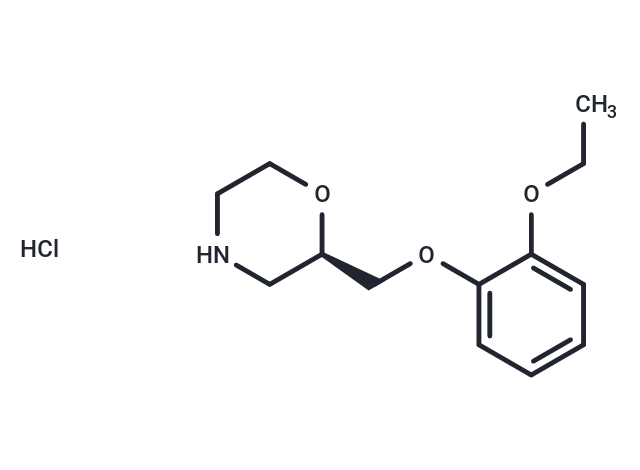
(R)-Viloxazine Hydrochloride
CAS No. 56287-63-9
(R)-Viloxazine Hydrochloride( —— )
Catalog No. M33812 CAS No. 56287-63-9
(R)-Viloxazine Hydrochloride is the R-isomer of Viloxazine, a selective norepinephrine reuptake inhibitor (NRI) used as an antidepressant.
Purity : >98% (HPLC)
 COA
Datasheet
HNMR
HPLC
MSDS
Handing Instructions
COA
Datasheet
HNMR
HPLC
MSDS
Handing Instructions
| Size | Price / USD | Stock | Quantity |
| 1 mL x 10 mM in DMSO | 98 | In Stock |


|
| 5MG | 107 | In Stock |
|
| 10MG | 157 | In Stock |
|
| 25MG | 236 | In Stock |
|
| 50MG | 324 | In Stock |
|
| 100MG | 442 | In Stock |
|
| 200MG | 594 | In Stock |
|
| 500MG | Get Quote | In Stock |
|
| 1G | Get Quote | In Stock |
|
Biological Information
-
Product Name(R)-Viloxazine Hydrochloride
-
NoteResearch use only, not for human use.
-
Brief Description(R)-Viloxazine Hydrochloride is the R-isomer of Viloxazine, a selective norepinephrine reuptake inhibitor (NRI) used as an antidepressant.
-
Description(R)-Viloxazine hydrochloride is a less active R-isomer of Viloxazine hydrochloride. Viloxazine hydrochloride is an effective antidepressant agent.
-
In Vitro——
-
In Vivo——
-
Synonyms——
-
PathwayEndocrinology/Hormones
-
TargetReductase
-
RecptorReductase
-
Research Area——
-
Indication——
Chemical Information
-
CAS Number56287-63-9
-
Formula Weight273.76
-
Molecular FormulaC13H20ClNO3
-
Purity>98% (HPLC)
-
Solubility——
-
SMILESCl.CCOc1ccccc1OC[C@H]1CNCCO1
-
Chemical Name——
Shipping & Storage Information
-
Storage(-20℃)
-
ShippingWith Ice Pack
-
Stability≥ 2 years
Reference
1. R Howe, et al. Optical isomers of 2-(2-ethoxyphenoxymethyl)tetrahydro-1,4-oxazine (viloxazine) and related compounds. J Med Chem. 1976 Aug;19(8):1074.?
molnova catalog



related products
-
Difubenzuron
Diflubenzuron is a benzoyl-urea insecticide, found to be a potent inhibitor of melanosome synthesis in mouse melanoma cells.
-
Turosteride
Turosteride is a small molecule steroidal 5α-reductase (5α-reductase) inhibitor.
-
Alrestatin
Alrestatin is a specific inhibitor of aldose reductase and attenuates glucose-induced angiotensin II production in rat vascular smooth muscle in vitro.
