


 Cart
Cart
 sales@molnova.com



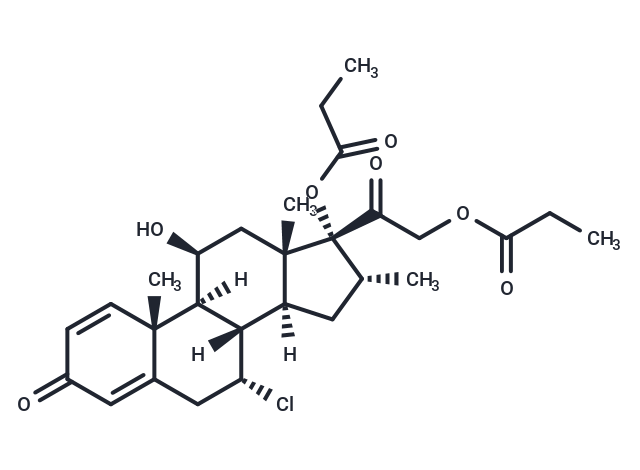
Alclometasone dipropionate
CAS No. 66734-13-2
Alclometasone dipropionate( —— )
Catalog No. M33722 CAS No. 66734-13-2
Alclometasone dipropionate (Sch 22219) is a synthetic glucocorticoid, a steroidal compound with antiproliferative, anti-inflammatory, anti-allergic, antipruritic, and vasoconstrictive properties, which is used in the study of skin inflammation.
Purity : >98% (HPLC)
 COA
Datasheet
HNMR
HPLC
MSDS
Handing Instructions
COA
Datasheet
HNMR
HPLC
MSDS
Handing Instructions
| Size | Price / USD | Stock | Quantity |
| 10MG | 66 | In Stock |


|
| 100MG | Get Quote | In Stock |
|
| 200MG | Get Quote | In Stock |
|
| 500MG | Get Quote | In Stock |
|
| 1G | Get Quote | In Stock |
|
Biological Information
-
Product NameAlclometasone dipropionate
-
NoteResearch use only, not for human use.
-
Brief DescriptionAlclometasone dipropionate (Sch 22219) is a synthetic glucocorticoid, a steroidal compound with antiproliferative, anti-inflammatory, anti-allergic, antipruritic, and vasoconstrictive properties, which is used in the study of skin inflammation.
-
DescriptionAlclometasone dipropionate (Sch 22219) is a steroid compound. Alclometasone dipropionate can be used for the research of dermatitis and skin itch.
-
In VitroAlclometasone dipropionate (0.01-100 ng/mL; 24 h) suppresses cytokine production of CD3/CD2 stimulation with IC50s of 5.54, 1.76, 2.09, 0.89, 3.26 and 0.76 ng/mL for IL-2, IL-3, IL-4, IL-5, IFN-γ and GM-CSF, respectively in human PBMC.
-
In VivoAlclometasone dipropionate (0.1% (20 μL); both sides of the ears; once) shows effects on tuberculin- and egg albumin-induced allergic reaction.Animal Model:Lewis rats with tuberculin-induced delayed allergic reactionDosage:0.1% (20 μL)Administration:Both sides of the ears; 0.1% (20 μL) 3 h before and 2 h after tuberculin challenge Result:Partially inhibited the increase in amount of dye leaked.Animal Model:Brown-Norway rats with egg albumin-induced passive cutaneous anaphylaxis reaction Dosage:0.1% (20 μL) Administration:Both sides of the ears; 0.1% (20 μL) 6 h before egg albumin challenge Result:Significantly suppressed the increase in amount of dye leaked in this passive cutaneous anaphylaxis reaction.
-
Synonyms——
-
PathwayOthers
-
TargetOther Targets
-
RecptorOthers
-
Research Area——
-
Indication——
Chemical Information
-
CAS Number66734-13-2
-
Formula Weight521.04
-
Molecular FormulaC28H37ClO7
-
Purity>98% (HPLC)
-
Solubility——
-
SMILESC(COC(CC)=O)(=O)[C@]1(OC(CC)=O)[C@]2(C)[C@@](C[C@H]1C)([C@]3([C@]([C@@H](O)C2)([C@]4(C)C(C[C@H]3Cl)=CC(=O)C=C4)[H])[H])[H]
-
Chemical Name——
Shipping & Storage Information
-
Storage(-20℃)
-
ShippingWith Ice Pack
-
Stability≥ 2 years
Reference
1. Sakuma S, et al. Tacrolimus suppressed the production of cytokines involved in atopic dermatitis by direct stimulation of human PBMC system. (Comparison with steroids). Int Immunopharmacol. 2001 Jun;1(6):1219-26.?
molnova catalog



related products
-
Tris(2-chloroethyl) ...
It is used as flame retardants.
-
NAG-thiazoline
NAG-thiazoline is an O-GlcNAcase inhibitor with Ki value of 180 nM. It is active against V. campbellii with MIC value of 0.5 μM.
-
Antiproliferative ag...
Antiproliferative agent-16 (Antiproliferative agent-16) is an indolyl hydrazide-hydrazone compound with anticancer activity. Antiproliferative agent-16 exhibits specificity toward breast cancer cells (IC50 of 6.94 μM for MCF-7 cells).
