


 Cart
Cart
 sales@molnova.com



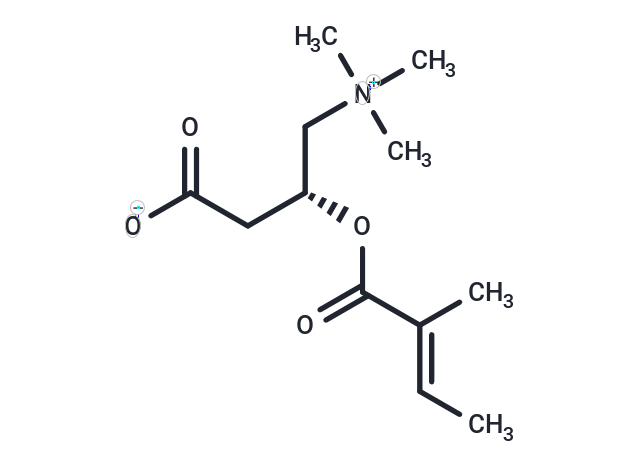
Tiglyl carnitine
CAS No. 64681-36-3
Tiglyl carnitine( —— )
Catalog No. M33623 CAS No. 64681-36-3
Tiglyl carnitine is associated with lung cancer and carnitine and glycine to 3-ketothiolase deficiency .
Purity : >98% (HPLC)
 COA
Datasheet
HNMR
HPLC
MSDS
Handing Instructions
COA
Datasheet
HNMR
HPLC
MSDS
Handing Instructions
| Size | Price / USD | Stock | Quantity |
| 1 mL x 10 mM in DMSO | 73 | In Stock |


|
| 5MG | 65 | In Stock |
|
| 10MG | 107 | In Stock |
|
| 25MG | 207 | In Stock |
|
| 50MG | 325 | In Stock |
|
| 100MG | Get Quote | In Stock |
|
| 200MG | Get Quote | In Stock |
|
| 500MG | Get Quote | In Stock |
|
| 1G | Get Quote | In Stock |
|
Biological Information
-
Product NameTiglyl carnitine
-
NoteResearch use only, not for human use.
-
Brief DescriptionTiglyl carnitine is associated with lung cancer and carnitine and glycine to 3-ketothiolase deficiency .
-
DescriptionTiglyl carnitine is found to be associated with celiac disease and mitochondrial acetoacetyl-CoA thiolase (T2) deficiency.
-
In Vitro——
-
In Vivo——
-
Synonyms——
-
PathwayProteasome/Ubiquitin
-
TargetEndogenous Metabolite
-
RecptorEndogenous Metabolite
-
Research Area——
-
Indication——
Chemical Information
-
CAS Number64681-36-3
-
Formula Weight243.3
-
Molecular FormulaC12H21NO4
-
Purity>98% (HPLC)
-
SolubilityIn Vitro:?DMSO : 25 mg/mL (102.75 mM; Ultrasonic (<60°C)
-
SMILESC\C=C(/C)C(=O)O[C@H](CC([O-])=O)C[N+](C)(C)C
-
Chemical Name——
Shipping & Storage Information
-
Storage(-20℃)
-
ShippingWith Ice Pack
-
Stability≥ 2 years
Reference
1. Fukao T, et al. The mitochondrial acetoacetyl-CoA thiolase (T2) deficiency in Japanese patients: urinary organic acid and blood acylcarnitine profiles under stable conditions have subtle abnormalities in T2-deficient patients with some residual T2 activit?
molnova catalog



related products
-
4-Methyl-1-phenyl-2-...
4-Methyl-1-phenyl-2-pentanone (Benzyl isobutyl ketone) is a volatile flavor compound utilized as a food additive.
-
γ-Cyclodextrin
Gamma cyclodextrin is a cycloamylose composed of eight alpha-(1->4) linked D-glucopyranose units found in some foods.
-
3-Hydroxyanthranilic...
3-Hydroxyanthranilic acid also known as 2-amino-3-hydroxy-benzoate or 3-ohaa belongs to the class of organic compounds known as hydroxybenzoic acid derivatives. 3-Hydroxyanthranilic acid has been found in human epidermis and bladder tissues and has also been detected in multiple biofluids such as urine and blood.
