


 Cart
Cart
 sales@molnova.com



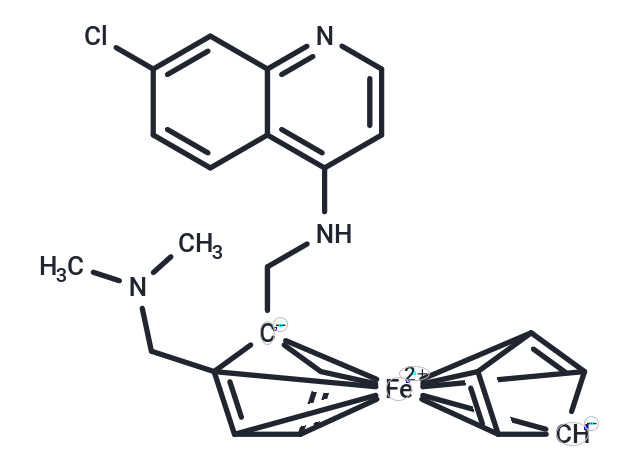
Ferroquine
CAS No. 185055-67-8
Ferroquine( —— )
Catalog No. M33358 CAS No. 185055-67-8
Ferroquine (Ferrochloroquine) is a ferrocenyl analogue of Chloroquine with antimalarial activity.
Purity : >98% (HPLC)
 COA
Datasheet
HNMR
HPLC
MSDS
Handing Instructions
COA
Datasheet
HNMR
HPLC
MSDS
Handing Instructions
| Size | Price / USD | Stock | Quantity |
| 1 mL x 10 mM in DMSO | 29 | In Stock |


|
| 10MG | 39 | In Stock |
|
| 25MG | 79 | In Stock |
|
| 50MG | 129 | In Stock |
|
| 100MG | 193 | In Stock |
|
| 200MG | Get Quote | In Stock |
|
| 500MG | Get Quote | In Stock |
|
| 1G | Get Quote | In Stock |
|
Biological Information
-
Product NameFerroquine
-
NoteResearch use only, not for human use.
-
Brief DescriptionFerroquine (Ferrochloroquine) is a ferrocenyl analogue of Chloroquine with antimalarial activity.
-
DescriptionFerroquine (Ferrochloroquine), a ferrocenyl analogue of Chloroquine, is an antimalarial agent. Ferroquine shows parasiticidal effect on Plasmodium by inducing oxidative stress and the subsequent destruction of the membrane.
-
In VitroFerroquine shows cytotoxicity against non-cancerous MRC-5 and HeLa cancer cells with IC50 values of 24.4 μM and 16.8 μM, respectively.24?hours post-incubation all newly transformed schistosomula (NTS)exposed to 33.3?μM Ferroquine shows strongly reduced viabilities.
-
In VivoTreatment of mice with 200 and 800?mg/kg Ferroquine, shows low total worm burden reductions of 19.4% and 35.6%. One of the mice treated with 800?mg/kg Ferroquine died within 24?hours post-treatment. No activity is observed treating mice with RQ at 200?mg/kg. Finally, a total worm burden reduction of 17.3% is observed following treatment with FQ-OH. Hence, modification ofChloroquine (CQ) by a ferrocenyl or ruthenocenyl fragment does not increase the antischistosomal properties of CQ. For comparison, at 200?mg/kg mefloquine (MQ) achieves a much higher worm burden reduction of 72.3% in S. mansoni-infected mice. A higher effect against female adult S. mansoni is also observed in MQ treated mice pointing to a sex-specific interference of these drugs with the target. Furthermore, in one of the FQ-OH treated mice many dead worms are recovered and a hepatic shift (i.e. worms migrating to the liver) observed. Hence, Ferroquine and FQ-OH show weak antischistosomal activity in vivo.
-
Synonyms——
-
PathwayOthers
-
TargetOther Targets
-
RecptorOthers
-
Research Area——
-
Indication——
Chemical Information
-
CAS Number185055-67-8
-
Formula Weight433.76
-
Molecular FormulaC23H24ClFeN3
-
Purity>98% (HPLC)
-
SolubilityIn Vitro:?DMSO : 4.35 mg/mL (10.03 mM; Ultrasonic (<60°C)
-
SMILESClC1=CC2=NC=CC(NC[C-]34[CH]5=[CH]6[CH]7=C3([Fe+2]675489%10%11[CH]%12=[CH]8[CH-]9[CH]%10=[CH]%12%11)CN(C)C)=C2C=C1
-
Chemical Name——
Shipping & Storage Information
-
Storage(-20℃)
-
ShippingWith Ice Pack
-
Stability≥ 2 years
Reference
1. Keiser J, et al. In vitro and in vivo antischistosomal activity of ferroquine derivatives. Parasit Vectors. 2014 Sep 4;7:424.?
molnova catalog



related products
-
Acid Red 73
Acid red 73 is a red dye.
-
CEF14, EBV Rta Prote...
CEF14, EBV Rta Protein (28-37) is the HLA a24-restricted epitope from the epstein-barr virus Rta Protein (28-37).
-
C. difficile Toxin B...
C. difficile Toxin B (232 - 241)
