


 Cart
Cart
 sales@molnova.com



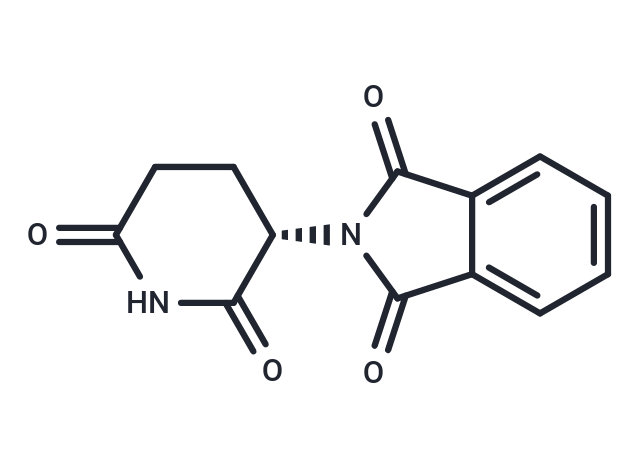
(S)-Thalidomide
CAS No. 841-67-8
(S)-Thalidomide( —— )
Catalog No. M33094 CAS No. 841-67-8
(S)-Thalidomide ((S)-(-)-Thalidomide) is the S-isomer of Thalidomide with immunomodulatory, anti-inflammatory, anticancer, anti-angiogenic, and pro-apoptotic activities, used in studying leprosy erythema nodosum and myeloma.
Purity : >98% (HPLC)
 COA
Datasheet
HNMR
HPLC
MSDS
Handing Instructions
COA
Datasheet
HNMR
HPLC
MSDS
Handing Instructions
| Size | Price / USD | Stock | Quantity |
| 5MG | 53 | In Stock |


|
| 10MG | 85 | In Stock |
|
| 25MG | 187 | In Stock |
|
| 50MG | 291 | In Stock |
|
| 100MG | 523 | In Stock |
|
| 200MG | Get Quote | In Stock |
|
| 500MG | 1107 | In Stock |
|
| 1G | Get Quote | In Stock |
|
Biological Information
-
Product Name(S)-Thalidomide
-
NoteResearch use only, not for human use.
-
Brief Description(S)-Thalidomide ((S)-(-)-Thalidomide) is the S-isomer of Thalidomide with immunomodulatory, anti-inflammatory, anticancer, anti-angiogenic, and pro-apoptotic activities, used in studying leprosy erythema nodosum and myeloma.
-
Description(S)-Thalidomide ((S)-(-)-Thalidomide) is the S-enantiomer of Thalidomide. (S)-Thalidomide has immunomodulatory, anti-inflammatory, antiangiogenic and pro-apoptotic effects. (S)-Thalidomide induces teratogenic effects by binding to cereblon (CRBN) .
-
In Vitro(S)-Thalidomide treatment results in a reduction in cell viability in U266 cells with an IC50 of 362 μM.(S)-Thalidomide treatment increased apoptosis in a dose-dependent manner in U266 cells.There are changes in the expression profile of genes involved in angiogenesis and apoptosis, but the changes are most dramatic in the apoptotic genes. In particular, the expression of I-κB kinase is decreased by two-fold, which is associated with a four-fold decrease in NF-κB expression. (S)-Thalidomide increases the Bax:Bcl-2 ratio, alsoincreases I-kB protein levels, and decreases NF-kB activity. A dramatic decrease in Bcl-2 expression with (S)-Thalidomide suggests a possible enhancement of cytotoxic effect if combined with other cytotoxic agents.Cell Viability Assay Cell Line:U266 MM cells Concentration:0 μM, 10 μM, 100 μM, 150 μM, 200 μM, 1000 μM Incubation Time:3 days Result:A reduction in cell viability was observed in U266 cells.Apoptosis Analysis Cell Line:U266 MM cells Concentration:100 μM, 150 μM, 200 μM, 1000 μM Incubation Time:3 days Result:Increased apoptosis in U266 cells.
-
In VivoThalidomide does cause limb reduction defects in chick embryos as long as the embryos are directly exposed to the drug. The most useful techniques are implanting Thalidomide-soaked beads into the embryo immediately adjacent to the limb territory or soaking presumptive chick limb territories in Thalidomide and then grafting the explants to a host embryo celom. Thalidomide affects the chick limb grafted to a host embryo in a dose response fashion. Furthermore, (S)-Thalidomide is more teratogenic than (R)-Thalidomide.
-
Synonyms——
-
PathwayApoptosis
-
TargetApoptosis
-
RecptorApoptosis
-
Research Area——
-
Indication——
Chemical Information
-
CAS Number841-67-8
-
Formula Weight258.23
-
Molecular FormulaC13H10N2O4
-
Purity>98% (HPLC)
-
SolubilityIn Vitro:?DMSO : 83.33 mg/mL (322.70 mM; Ultrasonic )
-
SMILESO=C1N(C(=O)C=2C1=CC=CC2)[C@@H]3C(=O)NC(=O)CC3
-
Chemical Name——
Shipping & Storage Information
-
Storage(-20℃)
-
ShippingWith Ice Pack
-
Stability≥ 2 years
Reference
1. Liu WM, et al. s-thalidomide has a greater effect on apoptosis than angiogenesis in a multiple myeloma cell line. Hematol J. 2004;5(3):247-54.?
molnova catalog



related products
-
SKI-178
SKI-178 is a sphingosine kinase 1 (SphK1) inhibitor with IC50 of 0.1-1.8 μM.?
-
Dihydrolycorine
Dihydrolycorine-HCL(DL) shows hypotensive effects, it can block alpha 1-adrenoceptors.
-
CP 461
CP 461 (UNII-68OJX9I7DT), a specific PDE2A inhibitor, is a novel pro-apoptotic compound that inhibits cyclic GMP phosphodiesterase but not cyclooxygenase-1 or -2.
