


 Cart
Cart
 sales@molnova.com



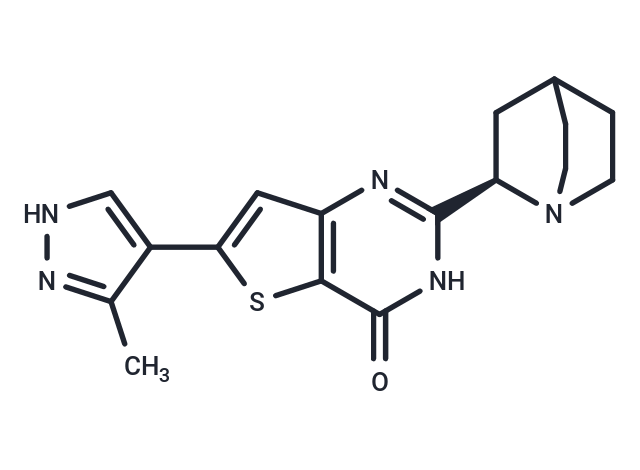
(R)-Simurosertib
CAS No. 1330782-69-8
(R)-Simurosertib( —— )
Catalog No. M33092 CAS No. 1330782-69-8
(R)-Simurosertib ((R)-TAK-931) is an ATP-competitive inhibitor of the cell division cycle 7 (CDC7) kinase.
Purity : >98% (HPLC)
 COA
Datasheet
HNMR
HPLC
MSDS
Handing Instructions
COA
Datasheet
HNMR
HPLC
MSDS
Handing Instructions
| Size | Price / USD | Stock | Quantity |
| 1 mL x 10 mM in DMSO | 67 | In Stock |


|
| 2MG | 28 | In Stock |
|
| 5MG | 46 | In Stock |
|
| 10MG | 73 | In Stock |
|
| 100MG | Get Quote | In Stock |
|
| 200MG | Get Quote | In Stock |
|
| 500MG | Get Quote | In Stock |
|
| 1G | Get Quote | In Stock |
|
Biological Information
-
Product Name(R)-Simurosertib
-
NoteResearch use only, not for human use.
-
Brief Description(R)-Simurosertib ((R)-TAK-931) is an ATP-competitive inhibitor of the cell division cycle 7 (CDC7) kinase.
-
Description(R)-Simurosertib ((R)-TAK-931) is the (R)-enantiomer of Simurosertib. Simurosertib (TAK-931) is an orally active, selective and ATP-competitive cell division cycle 7 (CDC7) kinase inhibitor, with an IC50 of <0.3 nM .
-
In Vitro——
-
In Vivo——
-
Synonyms——
-
PathwayCell Cycle/DNA Damage
-
TargetCDK
-
RecptorCDK
-
Research Area——
-
Indication——
Chemical Information
-
CAS Number1330782-69-8
-
Formula Weight341.43
-
Molecular FormulaC17H19N5OS
-
Purity>98% (HPLC)
-
SolubilityIn Vitro:?DMSO : 75 mg/mL (219.66 mM; Ultrasonic )
-
SMILESCc1n[nH]cc1-c1cc2nc([nH]c(=O)c2s1)[C@H]1CC2CCN1CC2
-
Chemical Name——
Shipping & Storage Information
-
Storage(-20℃)
-
ShippingWith Ice Pack
-
Stability≥ 2 years
Reference
1. K Iwai, et al. A novel CDC7-selective inhibitor TAK-931 with potent antitumor activity. European Journal of Cancer , 2016 , 69 (1) :S34.
molnova catalog



related products
-
Cdc7-IN-7
Cdc7-IN-7 is a potent inhibitor of Cdc7 kinase.
-
(R)-Enitociclib
(R)-Enitociclib, an enantiomer of BAY-1251152, is a CDK9 inhibitor with anticancer activity.
-
Riviciclib
A novel potent CDK inhibitor with IC50 of 79 nM, 63 nM and 20 nM for Cdk4/cyclin D1, Cdk1/cyclin B and Cdk9/cyclin T1, respectively.
