


 Cart
Cart
 sales@molnova.com



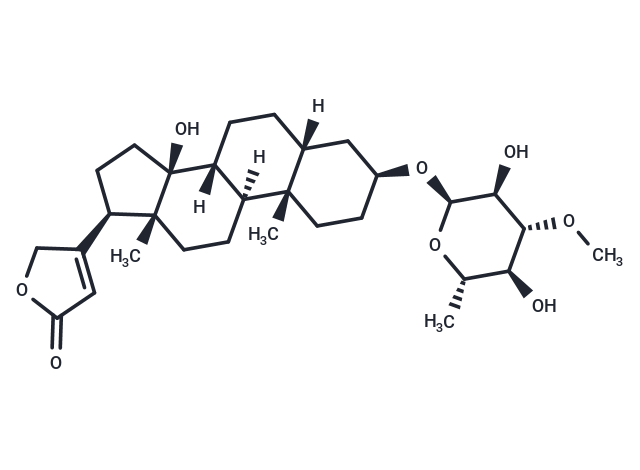
Neriifolin
CAS No. 466-07-9
Neriifolin( —— )
Catalog No. M33067 CAS No. 466-07-9
Neriifolin (17β-Neriifolin), a cardiac glycoside extracted from the unripe fruit of Cerbera manghas, is a Na+K+-ATPase inhibitor with anticancer activity that inhibits cell proliferation by suppressing HOXA9-dependent gene expression and inducing apoptosis in the human acute myeloid cell line, THP-1.
Purity : >98% (HPLC)
 COA
Datasheet
HNMR
HPLC
MSDS
Handing Instructions
COA
Datasheet
HNMR
HPLC
MSDS
Handing Instructions
| Size | Price / USD | Stock | Quantity |
| 2MG | 225 | In Stock |


|
| 100MG | Get Quote | In Stock |
|
| 200MG | Get Quote | In Stock |
|
| 500MG | Get Quote | In Stock |
|
| 1G | Get Quote | In Stock |
|
Biological Information
-
Product NameNeriifolin
-
NoteResearch use only, not for human use.
-
Brief DescriptionNeriifolin (17β-Neriifolin), a cardiac glycoside extracted from the unripe fruit of Cerbera manghas, is a Na+K+-ATPase inhibitor with anticancer activity that inhibits cell proliferation by suppressing HOXA9-dependent gene expression and inducing apoptosis in the human acute myeloid cell line, THP-1.
-
DescriptionNeriifolin, a CNS-penetrating cardiac glycoside, is an inhibitor of the Na+, K+-ATPase. Neriifolin can target beclin 1, inhibits the formation of LC3-associated phagosomes and ameliorates experimental autoimmune encephalomyelitis (EAE) development. Neriifolin induces cell cycle arrest and apoptosis in human hepatocellular carcinoma HepG2 cells[2.
-
In VitroNeriifolin (0.1μg/mL; 48 hours) induces apoptosis in HepG2 cells. Neriifolin (0-8 μg/mL; 72 hours) reduces viability of HepG2 cells. Neriifolin also induces S and G2/M phase arrests of the cell cycle and stimulates apoptosis of HepG2 cells. Stimulation of HepG2 cells with Neriifolin induced activation of caspase-3, -8, and -9, and up-regulated expression of Fas and FasL proteins.
-
In Vivo——
-
Synonyms——
-
PathwayAutophagy
-
TargetAutophagy
-
RecptorAutophagy | ATPase | Apoptosis
-
Research Area——
-
Indication——
Chemical Information
-
CAS Number466-07-9
-
Formula Weight534.68
-
Molecular FormulaC30H46O8
-
Purity>98% (HPLC)
-
SolubilityIn Vitro:?DMSO : 100 mg/mL (187.03 mM; Ultrasonic )
-
SMILESO[C@@]12[C@]3([C@@]([C@]4(C)[C@](CC3)(C[C@@H](O[C@H]5[C@@H](O)[C@H](OC)[C@@H](O)[C@H](C)O5)CC4)[H])(CC[C@]1(C)[C@H](CC2)C6=CC(=O)OC6)[H])[H]
-
Chemical Name——
Shipping & Storage Information
-
Storage(-20℃)
-
ShippingWith Ice Pack
-
Stability≥ 2 years
Reference
1. Keller CW, et al. ATG-dependent phagocytosis in dendritic cells drives myelin-specific CD4+ T cell pathogenicity during CNS inflammation. Proc Natl Acad Sci U S A. 2017;114(52):E11228-E11237.?
molnova catalog



related products
-
QN523?
QN523 represents a novel scaffold with drug-like properties, showing potent in vitro cytotoxicity in a panel of 12 cancer cell lines.
-
Ammonium Chloride
Ammonium chloride acts as a small molecule autophagy inhibitor.Ammonium chloride is a pH-regulating, heteropolar compound that can cause intracellular alkalosis and metabolic acidosis, thereby affecting enzyme activity and influencing processes in biological systems.
-
CC214-1
CC214-1 is an mTOR inhibitor with potential anticancer activity, inhibits protein translation, and induces autophagy.
