


 Cart
Cart
 sales@molnova.com



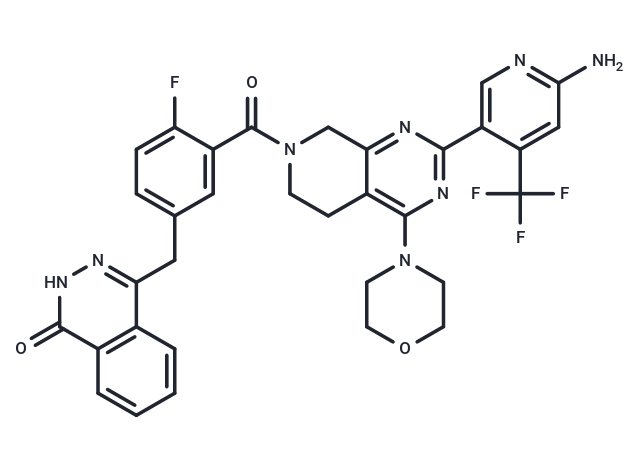
PARP,PI3K-IN-1
CAS No. 2337386-47-5
PARP,PI3K-IN-1( —— )
Catalog No. M33055 CAS No. 2337386-47-5
PARP/PI3K-IN-1 is a novel dual poly (ADP-ribose) polymerase (PARP) and phosphatidylinositol 3-kinase (PI3K) dual inhibitor with anticancer, antitumour and antiproliferative activities for the study of breast, pancreatic and lung cancers.
Purity : >98% (HPLC)
 COA
Datasheet
HNMR
HPLC
MSDS
Handing Instructions
COA
Datasheet
HNMR
HPLC
MSDS
Handing Instructions
| Size | Price / USD | Stock | Quantity |
| 5MG | 242 | In Stock |


|
| 10MG | 376 | In Stock |
|
| 25MG | 655 | In Stock |
|
| 50MG | 995 | In Stock |
|
| 100MG | 1349 | In Stock |
|
| 200MG | Get Quote | In Stock |
|
| 500MG | Get Quote | In Stock |
|
| 1G | Get Quote | In Stock |
|
Biological Information
-
Product NamePARP,PI3K-IN-1
-
NoteResearch use only, not for human use.
-
Brief DescriptionPARP/PI3K-IN-1 is a novel dual poly (ADP-ribose) polymerase (PARP) and phosphatidylinositol 3-kinase (PI3K) dual inhibitor with anticancer, antitumour and antiproliferative activities for the study of breast, pancreatic and lung cancers.
-
DescriptionPARP/PI3K-IN-1 (compound 15) is a potent PARP/PI3K inhibitor with pIC50 values of 8.22, 8.44, 8.25, 6.54, 8.13, 6.08 for PARP-1, PARP-2, PI3Kα, PI3Kβ, PI3Kδ, and PI3Kγ, respectively. PARP/PI3K-IN-1 is a highly effective anticancer compound targeted against a wide range of oncologic diseases.
-
In VitroPARP/PI3K-IN-1 (compound 15; 1 μM; 72 hours) leads to a significant increase in cell apoptosis. PARP/PI3K-IN-1 (1 μM; 72 hours) reduces the autophosphorylation levels of AKT and S6 while increases the autophosphorylation level of ERK after treating cells, indicating that it can inhibit the PI3K pathway and activate the ERK pathway. PARP/PI3K-IN-1 (1 μM) displays a strong capability to downregulate the expression of BRCA1/2 at the mRNA level in MDA-MB-468 cancer cells. PARP/PI3K-IN-1 not only shows significant inhibitory activity against BRCA-deficient cells HCC1937 and HCT116, but also displays potent anti-proliferative activity against BRCA-proficient cells MDA-MB-231 and MDA-MB-468. Apoptosis Analysis Cell Line:MDA-MB-468 cancer cells Concentration:1 μM Incubation Time:72 hours Result:Led to a significant increase in cell apoptosis. Western Blot Analysis Cell Line:MDA-MB-468 cancer cells Concentration:1 μM Incubation Time:72 hours Result:Reduced the autophosphorylation levels of AKT and S6 while increased the autophosphorylation level of ERK after treating cells.
-
In VivoPARP/PI3K-IN-1 (i.p.; 50 mg/kg; twice daily (BID) for 34 consecutive days) significantly suppresses the tumor growth.Animal Model:Six-week-old male BALB/c nude mice with MDA-MB-468 cells Dosage:50 mg/kg Administration:i.p.; twice daily (BID) for 34 consecutive days Result:Significantly suppressed the tumor growth.
-
Synonyms——
-
PathwayPI3K/Akt/mTOR signaling
-
TargetPI3K
-
RecptorPI3K | PARP
-
Research Area——
-
Indication——
Chemical Information
-
CAS Number2337386-47-5
-
Formula Weight660.62
-
Molecular FormulaC33H28F4N8O3
-
Purity>98% (HPLC)
-
SolubilityIn Vitro:?DMSO : 100 mg/mL (151.37 mM; Ultrasonic )
-
SMILESO=C1NN=C(C=2C=CC=CC12)CC3=CC=C(F)C(=C3)C(=O)N4CC5=NC(=NC(=C5CC4)N6CCOCC6)C7=CN=C(N)C=C7C(F)(F)F
-
Chemical Name——
Shipping & Storage Information
-
Storage(-20℃)
-
ShippingWith Ice Pack
-
Stability≥ 2 years
Reference
1. Wang J, et al.Discovery of Novel Dual Poly(ADP-ribose)polymerase and Phosphoinositide 3-Kinase Inhibitors as a Promising Strategy for Cancer Therapy.J Med Chem. 2020 Jan 9;63(1):122-139.?
molnova catalog



related products
-
PKI-402
A potent dual PI3K/mTOR inhibitor.
-
PF-04979064
A highly potent and selective, dual PI3K/mTOR inhibitor.
-
Alkannin
Shikonin is a natural red naphthoquinone pigment has antimicrobial anti-tumor and anti-inflammatory effects; a purified shikonin preparation is widely used for the production of medicinals cosmetics and some food products; shikonin also enters into the antiinflammatory ointment and cream compositions used for the treatment of burns.
