


 Cart
Cart
 sales@molnova.com



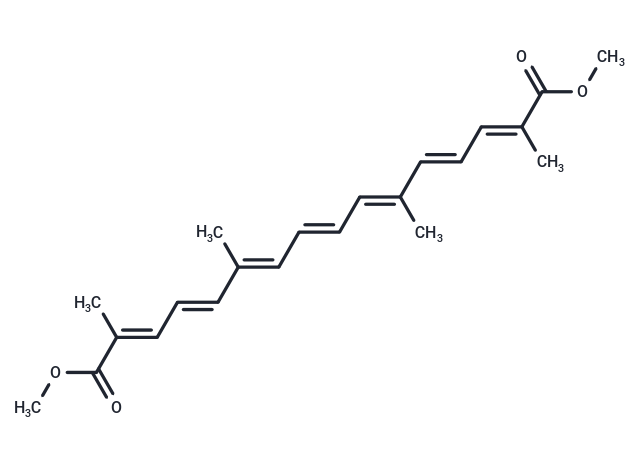
Crocetine dimethyl ester
CAS No. 5892-54-6
Crocetine dimethyl ester( —— )
Catalog No. M32866 CAS No. 5892-54-6
Crocetine dimethyl ester (Dimethylcrocetin) is a saffronin derivative exhibiting antioxidant properties, inhibition of AChE activity, and suppression of cell growth and differentiation.
Purity : >98% (HPLC)
 COA
Datasheet
HNMR
HPLC
MSDS
Handing Instructions
COA
Datasheet
HNMR
HPLC
MSDS
Handing Instructions
| Size | Price / USD | Stock | Quantity |
| 5MG | 312 | In Stock |


|
| 10MG | 467 | In Stock |
|
| 25MG | 748 | In Stock |
|
| 50MG | 995 | In Stock |
|
| 100MG | Get Quote | In Stock |
|
| 200MG | Get Quote | In Stock |
|
| 500MG | Get Quote | In Stock |
|
| 1G | Get Quote | In Stock |
|
Biological Information
-
Product NameCrocetine dimethyl ester
-
NoteResearch use only, not for human use.
-
Brief DescriptionCrocetine dimethyl ester (Dimethylcrocetin) is a saffronin derivative exhibiting antioxidant properties, inhibition of AChE activity, and suppression of cell growth and differentiation.
-
DescriptionCrocetine dimethyl ester (Dimethylcrocetin) is found in the stigmas of saffron (Crocus sativus L.), and has antioxidant activity.
-
In Vitro——
-
In Vivo——
-
Synonyms——
-
PathwayOthers
-
TargetAntioxidant
-
RecptorAntioxidant
-
Research Area——
-
Indication——
Chemical Information
-
CAS Number5892-54-6
-
Formula Weight356.46
-
Molecular FormulaC22H28O4
-
Purity>98% (HPLC)
-
Solubility——
-
SMILESC(\C=C\C(=C\C=C\C=C(\C=C\C=C(\C(OC)=O)/C)/C)\C)=C(/C(OC)=O)\C
-
Chemical Name——
Shipping & Storage Information
-
Storage(-20℃)
-
ShippingWith Ice Pack
-
Stability≥ 2 years
Reference
1. Kanakis CD, et al, Crocetin, dimethylcrocetin, and safranal bind human serum albumin: stability and antioxidative properties. J Agric Food Chem. 2007 Feb 7;55(3):970-7.?
molnova catalog



related products
-
Lecanoric acid
Lecanoric acid is a compound derived from Lecanoric acid, which has antioxidant activity and promotes the growth of probiotics.
-
Se-DMC
Se-DMC has antioxidant, anti-damage and anti-edema properties and can be used to study diseases related to metabolism and inflammation.
-
NSC 31150
NSC 31150 is a potential PPAR agonist with antibacterial, antidiabetic and antioxidant activities and may be used to study cancer and bacterial infections.
