


 Cart
Cart
 sales@molnova.com



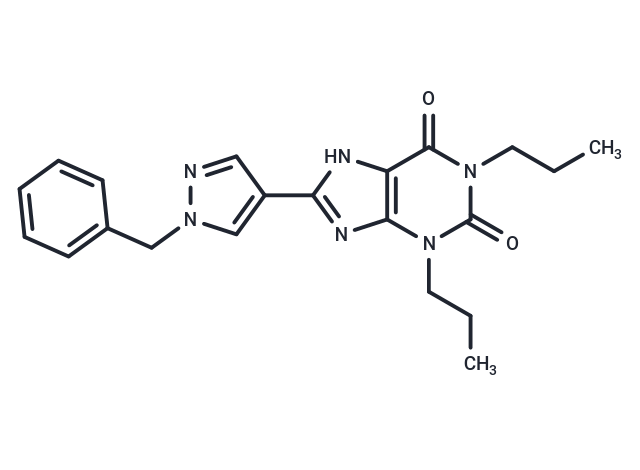
A2B receptor antagonist 1
CAS No. 531506-36-2
A2B receptor antagonist 1( —— )
Catalog No. M32740 CAS No. 531506-36-2
A2B receptor antagonist 1 (EXAMPLE 9B) is a potent A2B adenosine receptor antagonist.
Purity : >98% (HPLC)
 COA
Datasheet
HNMR
HPLC
MSDS
Handing Instructions
COA
Datasheet
HNMR
HPLC
MSDS
Handing Instructions
| Size | Price / USD | Stock | Quantity |
| 1 mL x 10 mM in DMSO | 844 | In Stock |


|
| 5MG | 735 | In Stock |
|
| 10MG | 938 | In Stock |
|
| 25MG | 1473 | In Stock |
|
| 50MG | 1841 | In Stock |
|
| 100MG | 2613 | In Stock |
|
| 200MG | Get Quote | In Stock |
|
| 500MG | Get Quote | In Stock |
|
| 1G | Get Quote | In Stock |
|
Biological Information
-
Product NameA2B receptor antagonist 1
-
NoteResearch use only, not for human use.
-
Brief DescriptionA2B receptor antagonist 1 (EXAMPLE 9B) is a potent A2B adenosine receptor antagonist.
-
DescriptionA2B receptor antagonist 1 is a potent A2B adenosine receptor antagonist extracted from patent WO 2009157938 A1 EXAMPLE 9B.
-
In Vitro——
-
In Vivo——
-
Synonyms——
-
PathwayGPCR/G Protein
-
TargetAdenosine Receptor
-
RecptorAdenosine Receptor
-
Research Area——
-
Indication——
Chemical Information
-
CAS Number531506-36-2
-
Formula Weight392.45
-
Molecular FormulaC21H24N6O2
-
Purity>98% (HPLC)
-
Solubility——
-
SMILESC(CC)N1C2=C(NC(=N2)C3=CN(CC4=CC=CC=C4)N=C3)C(=O)N(CCC)C1=O
-
Chemical Name——
Shipping & Storage Information
-
Storage(-20℃)
-
ShippingWith Ice Pack
-
Stability≥ 2 years
Reference
1. Rao Kalla, et al. A2b adenosine receptor antagonists for treating cancer. WO 2009157938 A1.
molnova catalog



related products
-
Trabodenoson
Trabodenoson (INO-8875) is a selective and potent adenosine A1 receptor agonist, an adenosine analog, for the study of primary open-angle glaucoma.
-
AZD-4635
AZD-4635 (HTL 1071) is a potent, selective and orally available adenosine 2A receptor (A2AR) inhibitor with Ki of 1.7 nM.
-
Evodenoson
Evodenoson (ATL313) is a potent and selective adenosine A2a receptor (A2aR) agonist for the treatment of eye diseases, tumors, and immune system disorders, and may be used in studies of open-angle glaucoma and blood tumors.
