


 Cart
Cart
 sales@molnova.com



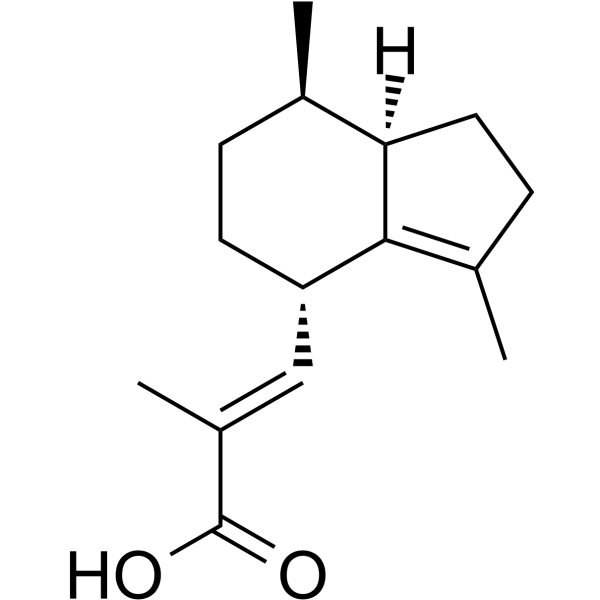
Valerenic acid
CAS No. 3569-10-6
Valerenic acid( —— )
Catalog No. M32098 CAS No. 3569-10-6
Valerenic acid is a natural product.
Purity : >98% (HPLC)
 COA
Datasheet
HNMR
HPLC
MSDS
Handing Instructions
COA
Datasheet
HNMR
HPLC
MSDS
Handing Instructions
| Size | Price / USD | Stock | Quantity |
| 10MG | 342 | In Stock |


|
| 50MG | Get Quote | In Stock |
|
| 100MG | Get Quote | In Stock |
|
| 200MG | Get Quote | In Stock |
|
| 500MG | Get Quote | In Stock |
|
| 1G | Get Quote | In Stock |
|
Biological Information
-
Product NameValerenic acid
-
NoteResearch use only, not for human use.
-
Brief DescriptionValerenic acid is a natural product.
-
DescriptionValerenic acid is a natural product.
-
In VitroValerenic acid (1-100 μM) enhances the whole cell currents on GABAA receptors expressed in HEK 293 cells.Valerenic acid exhibits significant affinity for the 5-HT5a receptor, with an IC50 of 17.2 μM (Ki=10.7 μM).[3H]Valerenic acid binds to brain membranes reveals both a high affinity binding site (KD=25 nM) and a low affinity site (KD=16 μM).[3H]Valerenic acid is displaced by Valerenol with high potency (IC50=3 nM).
-
In VivoValerenic acid (1-6 mg/kg i.p. or 10 mg/kg p.o.) decreases the aversion of wild type mice to the lit area.Valerenic acid (10 mg/kg; p.o.) increases the proportion of time 129X1/SvJ mice spent onto the open arms.
-
Synonyms——
-
PathwayOthers
-
TargetOther Targets
-
Recptor——
-
Research Area——
-
Indication——
Chemical Information
-
CAS Number3569-10-6
-
Formula Weight234.3
-
Molecular FormulaC15H22O2
-
Purity>98% (HPLC)
-
Solubility——
-
SMILES——
-
Chemical Name——
Shipping & Storage Information
-
Storage(-20℃)
-
ShippingWith Ice Pack
-
Stability≥ 2 years
Reference
molnova catalog



related products
-
6-Methoxykaempferol
6-Methoxykaempferol is a flavonoid found in brazilian propolis. 6-Methoxykaempferol has anti-proliferative activity against cancer cells, neuroprotective effects on isolated rat brain synaptosomes and reduces glutathione levels.
-
GS 39783
GS 39783 is a positive allosteric modulator (PAM) of GABABR, which reduces the motivational properties of alcohol and the conditioned reinforcement and conditional reward of psychostimulants.
-
Sitafloxacin Hydrate
Sitafloxacin (INN; also called DU-6859a) is a fluoroquinolone antibiotic that shows promise in the treatment of Buruli ulcer.
