


 Cart
Cart
 sales@molnova.com



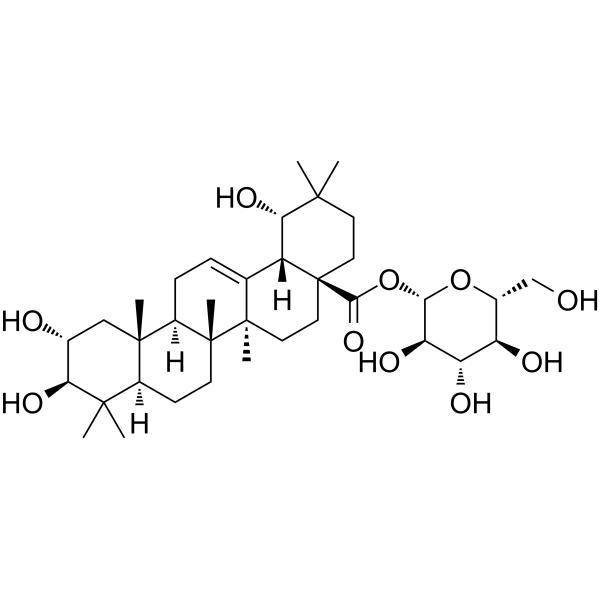
Arjunetin
CAS No. 31297-79-7
Arjunetin( —— )
Catalog No. M31949 CAS No. 31297-79-7
Arjunetin, an insect feeding-deterrent and growth inhibitor, shows antioxidant and anti-inflammatory activities.
Purity : >98% (HPLC)
 COA
Datasheet
HNMR
HPLC
MSDS
Handing Instructions
COA
Datasheet
HNMR
HPLC
MSDS
Handing Instructions
| Size | Price / USD | Stock | Quantity |
| 5MG | 282 | In Stock |


|
| 10MG | 420 | In Stock |
|
| 25MG | 681 | In Stock |
|
| 50MG | 919 | In Stock |
|
| 100MG | Get Quote | In Stock |
|
| 200MG | Get Quote | In Stock |
|
| 500MG | Get Quote | In Stock |
|
| 1G | Get Quote | In Stock |
|
Biological Information
-
Product NameArjunetin
-
NoteResearch use only, not for human use.
-
Brief DescriptionArjunetin, an insect feeding-deterrent and growth inhibitor, shows antioxidant and anti-inflammatory activities.
-
DescriptionArjunetin, an insect feeding-deterrent and growth inhibitor, shows antioxidant and anti-inflammatory activities.
-
In VitroArjunetin shows growth inhibitory and feeding-deterrent properties with a GI50 and feeding-inhibition (FD50) of 188.5 and 287.1 μg/g diet, respectively.
-
In Vivo——
-
Synonyms——
-
PathwayOthers
-
TargetOther Targets
-
Recptor——
-
Research Area——
-
Indication——
Chemical Information
-
CAS Number31297-79-7
-
Formula Weight650.9
-
Molecular FormulaC36H58O10
-
Purity>98% (HPLC)
-
Solubility——
-
SMILES——
-
Chemical Name——
Shipping & Storage Information
-
Storage(-20℃)
-
ShippingWith Ice Pack
-
Stability≥ 2 years
Reference
molnova catalog



related products
-
Theralizumab
Theralizumab (TGN1412) is an anti-CD28-targeting monoclonal antibody that directly stimulates T cells.
-
Anecortave Acetate
Anecortave Acetate, an angiostatic steroid, is used for proteomics research.
-
2H-Naphth[2′,1′:4,5]...
2H-Naphth[2′,1′:4,5]indeno[1,2-d][1,3]dioxole, pregn-4-ene-3,20-dione deriv showed high local anti-inflammatory potency and high lung selectivity when tested on Sprague Dawley rats.
