


 Cart
Cart
 sales@molnova.com



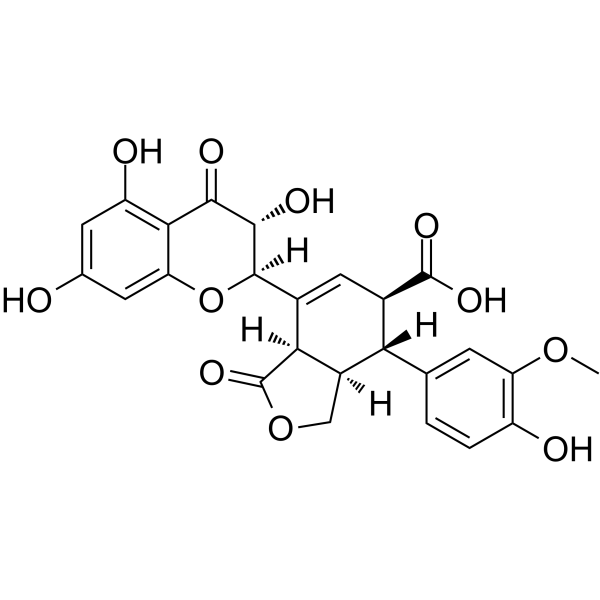
Silyamandin
CAS No. 1009565-36-9
Silyamandin( —— )
Catalog No. M31943 CAS No. 1009565-36-9
Silyamandin may have antihepatotoxic and chemopreventive activities.
Purity : >98% (HPLC)
 COA
Datasheet
HNMR
HPLC
MSDS
Handing Instructions
COA
Datasheet
HNMR
HPLC
MSDS
Handing Instructions
| Size | Price / USD | Stock | Quantity |
| 5MG | 351 | In Stock |


|
| 50MG | Get Quote | In Stock |
|
| 100MG | Get Quote | In Stock |
|
| 200MG | Get Quote | In Stock |
|
| 500MG | Get Quote | In Stock |
|
| 1G | Get Quote | In Stock |
|
Biological Information
-
Product NameSilyamandin
-
NoteResearch use only, not for human use.
-
Brief DescriptionSilyamandin may have antihepatotoxic and chemopreventive activities.
-
DescriptionSilyamandin may have antihepatotoxic and chemopreventive activities.
-
In Vitro——
-
In Vivo——
-
Synonyms——
-
PathwayOthers
-
TargetOther Targets
-
Recptor——
-
Research Area——
-
Indication——
Chemical Information
-
CAS Number1009565-36-9
-
Formula Weight498.4
-
Molecular FormulaC25H22O11
-
Purity>98% (HPLC)
-
Solubility——
-
SMILES——
-
Chemical Name——
Shipping & Storage Information
-
Storage(-20℃)
-
ShippingWith Ice Pack
-
Stability≥ 2 years
Reference
molnova catalog



related products
-
Elgodipine
Elgodipine significantly reduced the incidence and severity of exercise-induced angina pectoris systemically and was able to inhibit vascular smooth muscle proliferation through a mechanism independent of the expression of the transcription factors c-fos and c-jun.
-
(Iso)-Atagabalin HCl
(Iso)-Atagabalin HCl(isomer-Atagabalin HCl) is an alpha -2- delta ligand that can be used to treat non-restorative sleep.
-
TMPA
TMPA is a nuclear receptor Nur77 and LKB1 interaction antagonist.
