


 Cart
Cart
 sales@molnova.com


 Home -
Products -
Others -
Other Targets -
Quercetin 3-O-beta-(6-p-coumaroyl)glucopyranosyl(1->2)-alpha-L-rhamnopyranoside
Home -
Products -
Others -
Other Targets -
Quercetin 3-O-beta-(6-p-coumaroyl)glucopyranosyl(1->2)-alpha-L-rhamnopyranoside
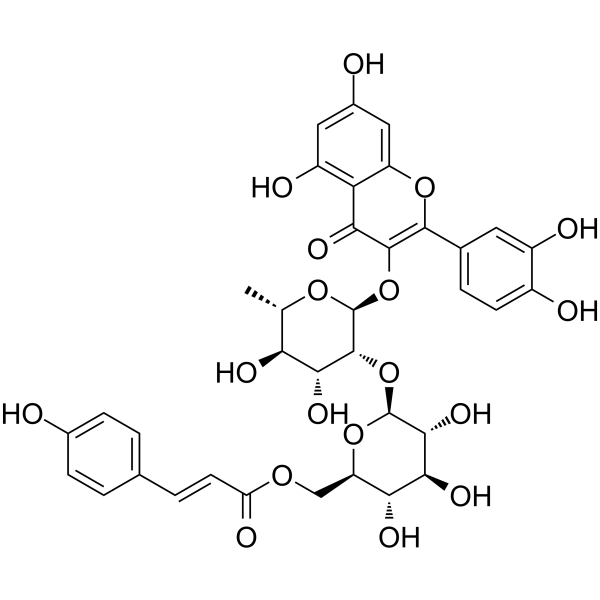
Quercetin 3-O-beta-(6-p-coumaroyl)glucopyranosyl(1->2)-alpha-L-rhamnopyranoside
CAS No. 143061-65-8
Quercetin 3-O-beta-(6-p-coumaroyl)glucopyranosyl(1->2)-alpha-L-rhamnopyranoside( —— )
Catalog No. M31805 CAS No. 143061-65-8
Quercetin 3-O-β-D-(6''-p-coumaroyl)glucopyranosyl(1→2)-α-L-rhamnopyranoside is a compound extracted from the leaves of Ginkgo biloba.
Purity : >98% (HPLC)
 COA
Datasheet
HNMR
HPLC
MSDS
Handing Instructions
COA
Datasheet
HNMR
HPLC
MSDS
Handing Instructions
| Size | Price / USD | Stock | Quantity |
| 1 mL x 10 mM in DMSO | 306 | In Stock |


|
| 5MG | 215 | In Stock |
|
| 10MG | 317 | In Stock |
|
| 100MG | Get Quote | In Stock |
|
| 200MG | Get Quote | In Stock |
|
| 500MG | Get Quote | In Stock |
|
| 1G | Get Quote | In Stock |
|
Biological Information
-
Product NameQuercetin 3-O-beta-(6-p-coumaroyl)glucopyranosyl(1->2)-alpha-L-rhamnopyranoside
-
NoteResearch use only, not for human use.
-
Brief DescriptionQuercetin 3-O-β-D-(6''-p-coumaroyl)glucopyranosyl(1→2)-α-L-rhamnopyranoside is a compound extracted from the leaves of Ginkgo biloba.
-
DescriptionQuercetin 3-O-β-D-(6''-p-coumaroyl)glucopyranosyl(1→2)-α-L-rhamnopyranoside is a compound extracted from the leaves of Ginkgo biloba. Quercetin 3-o - -(6 '-p-coumaryl) glucopyranose (1->2) -α-L-rhamnoside has antioxidant properties.
-
In Vitro——
-
In Vivo——
-
Synonyms——
-
PathwayOthers
-
TargetOther Targets
-
Recptor——
-
Research Area——
-
Indication——
Chemical Information
-
CAS Number143061-65-8
-
Formula Weight756.7
-
Molecular FormulaC36H36O18
-
Purity>98% (HPLC)
-
Solubility——
-
SMILES——
-
Chemical Name——
Shipping & Storage Information
-
Storage(-20℃)
-
ShippingWith Ice Pack
-
Stability≥ 2 years
Reference
molnova catalog



related products
-
Myricetin 3-methyl-3...
Myricetin 3'-methyl-3-O-rutinoside
-
Cinepazide
A cerebral vasodilator that acts as a calcium blocker.
-
Gliadin (43-49)(Glia...
α-Gliadin (43-49) is the major protein component of gluten. α-Gliadin (43-49) can be used in theimmunological response to α-gliadin.
