


 Cart
Cart
 sales@molnova.com



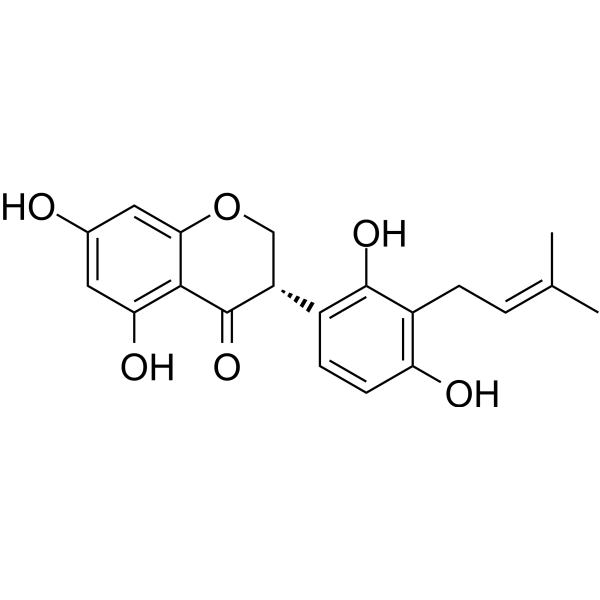
Dihydrolicoisoflavone
CAS No. 164163-92-2
Dihydrolicoisoflavone( —— )
Catalog No. M31758 CAS No. 164163-92-2
Dihydrolicoisoflavone A possesses weaker anti-H. pylori activity, it may be useful chemopreventive agents for peptic ulcer or gastric cancer in H. pylori-infected individuals.
Purity : >98% (HPLC)
 COA
Datasheet
HNMR
HPLC
MSDS
Handing Instructions
COA
Datasheet
HNMR
HPLC
MSDS
Handing Instructions
| Size | Price / USD | Stock | Quantity |
| 5MG | 657 | In Stock |


|
| 50MG | Get Quote | In Stock |
|
| 100MG | Get Quote | In Stock |
|
| 200MG | Get Quote | In Stock |
|
| 500MG | Get Quote | In Stock |
|
| 1G | Get Quote | In Stock |
|
Biological Information
-
Product NameDihydrolicoisoflavone
-
NoteResearch use only, not for human use.
-
Brief DescriptionDihydrolicoisoflavone A possesses weaker anti-H. pylori activity, it may be useful chemopreventive agents for peptic ulcer or gastric cancer in H. pylori-infected individuals.
-
DescriptionDihydrolicoisoflavone A possesses weaker anti-H. pylori activity, it may be useful chemopreventive agents for peptic ulcer or gastric cancer in H. pylori-infected individuals.
-
In Vitro——
-
In Vivo——
-
Synonyms——
-
PathwayOthers
-
TargetOther Targets
-
Recptor——
-
Research Area——
-
Indication——
Chemical Information
-
CAS Number164163-92-2
-
Formula Weight356.4
-
Molecular FormulaC20H20O6
-
Purity>98% (HPLC)
-
Solubility——
-
SMILES——
-
Chemical Name——
Shipping & Storage Information
-
Storage(-20℃)
-
ShippingWith Ice Pack
-
Stability≥ 2 years
Reference
molnova catalog



related products
-
Cimicifugoside
Cimicifugoside a triterpenoid isolated from Cimicifuga simplex is a novel specific nucleoside transport inhibitor. It also shows immunosuppressive activity.
-
Diclofenac Amide
Used as a intermediates of Diclofenac.
-
Zedoarondiol
Zedoarondiol has anti-inflammatory activity, inhibits iNOS, COX-2, and pro-inflammatory cytokine expressions by suppressing the phosphorylations of IKK and MAPKs, and by subsequently inactivating the NF-kappaB pathway.
