


 Cart
Cart
 sales@molnova.com



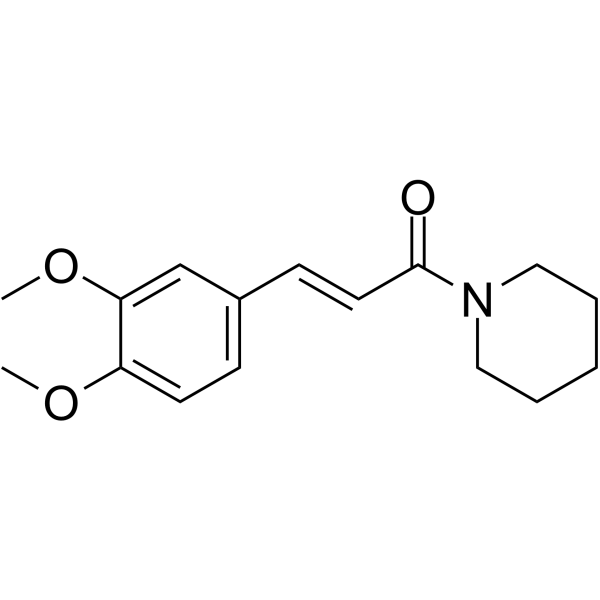
1-(3,4-Dimethoxycinnamoyl)piperidine
CAS No. 128261-84-7
1-(3,4-Dimethoxycinnamoyl)piperidine( —— )
Catalog No. M31408 CAS No. 128261-84-7
1-(3,4-Dimethoxycinnamoyl)piperidine is a natural product.
Purity : >98% (HPLC)
 COA
Datasheet
HNMR
HPLC
MSDS
Handing Instructions
COA
Datasheet
HNMR
HPLC
MSDS
Handing Instructions
| Size | Price / USD | Stock | Quantity |
| 50MG | Get Quote | In Stock |


|
| 100MG | Get Quote | In Stock |
|
| 200MG | Get Quote | In Stock |
|
| 500MG | Get Quote | In Stock |
|
| 1G | Get Quote | In Stock |
|
Biological Information
-
Product Name1-(3,4-Dimethoxycinnamoyl)piperidine
-
NoteResearch use only, not for human use.
-
Brief Description1-(3,4-Dimethoxycinnamoyl)piperidine is a natural product.
-
Description1-(3,4-Dimethoxycinnamoyl)piperidine is a natural product.
-
In Vitro——
-
In Vivo——
-
Synonyms——
-
PathwayOthers
-
TargetOther Targets
-
Recptor——
-
Research Area——
-
Indication——
Chemical Information
-
CAS Number128261-84-7
-
Formula Weight275.4
-
Molecular FormulaC16H21NO3
-
Purity>98% (HPLC)
-
Solubility——
-
SMILES——
-
Chemical Name——
Shipping & Storage Information
-
Storage(-20℃)
-
ShippingWith Ice Pack
-
Stability≥ 2 years
Reference
molnova catalog



related products
-
Span-85
Span is a synthetic non-ionic emulsifier, which is prepared by partial esterification of sorbitol or sorbitan with food grade palmitic acid.
-
Higenamine?Hydrochlo...
Higenamine(Hydrochloride) has been demonstrated to be a?β2?adrenoreceptor agonist.
-
3-O-methylellagic ac...
3-O-methylellagic acid 4'-O-alpha-L-rhamnopyranoside is a natural product for research related to life sciences.
