


 Cart
Cart
 sales@molnova.com



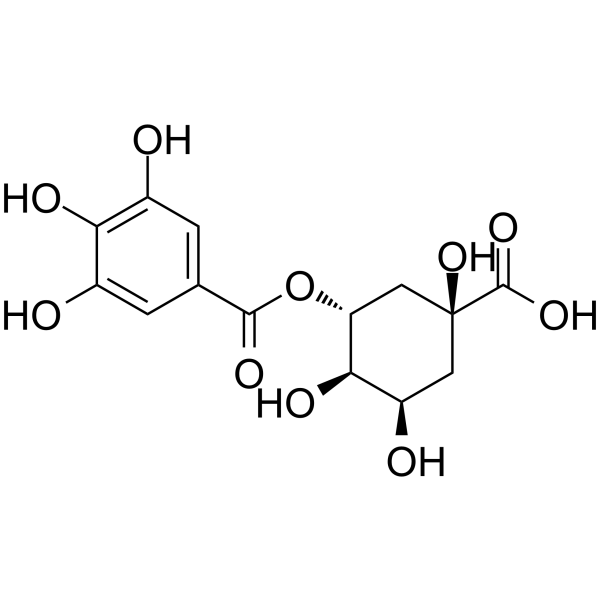
3-Galloylquinic acid
CAS No. 17365-11-6
3-Galloylquinic acid( —— )
Catalog No. M31343 CAS No. 17365-11-6
Theogallin is an active ingredient in decaffeinated green tea extract, has cognition enhancing effect and antidepressive.
Purity : >98% (HPLC)
 COA
Datasheet
HNMR
HPLC
MSDS
Handing Instructions
COA
Datasheet
HNMR
HPLC
MSDS
Handing Instructions
| Size | Price / USD | Stock | Quantity |
| 5MG | 758 | In Stock |


|
| 50MG | Get Quote | In Stock |
|
| 100MG | Get Quote | In Stock |
|
| 200MG | Get Quote | In Stock |
|
| 500MG | Get Quote | In Stock |
|
| 1G | Get Quote | In Stock |
|
Biological Information
-
Product Name3-Galloylquinic acid
-
NoteResearch use only, not for human use.
-
Brief DescriptionTheogallin is an active ingredient in decaffeinated green tea extract, has cognition enhancing effect and antidepressive.
-
DescriptionTheogallin is an active ingredient in decaffeinated green tea extract, has cognition enhancing effect and antidepressive.
-
In Vitro——
-
In VivoTheogallin shows a power decreasing effect on cortical activity. Animal Model:Adult Fisher rats (6-months-old)Dosage:20 mg/kg Administration:Oral administration Result:Showed a power decreasing effect on cortical activity.
-
Synonyms——
-
PathwayOthers
-
TargetOther Targets
-
Recptor——
-
Research Area——
-
Indication——
Chemical Information
-
CAS Number17365-11-6
-
Formula Weight344.3
-
Molecular FormulaC14H16O10
-
Purity>98% (HPLC)
-
Solubility——
-
SMILES——
-
Chemical Name——
Shipping & Storage Information
-
Storage(-20℃)
-
ShippingWith Ice Pack
-
Stability≥ 2 years
Reference
molnova catalog



related products
-
Nortracheloside
Nortracheloside is a natural product of Trachelospermum, Apocynaceae.Nortracheloside can be used as a reference standard.
-
(+)-Shikonin
Shikonin is an TMEM16A chloride channel inhibitor (IC50: 6.5 μM). Shikonin is also a selective PKM2 inhibitor and can also suppress activation of the NF-κB pathway and inhibit TNF-α.
-
Coelenteramine 400a
Coelenteramine 400a (Coelenterazine 400a), a Coelenterazine derivative, serves as a substrate for Renilla luciferase (RLuc), facilitating the emission of blue light at 395 nm.
