


 Cart
 sales@molnova.com




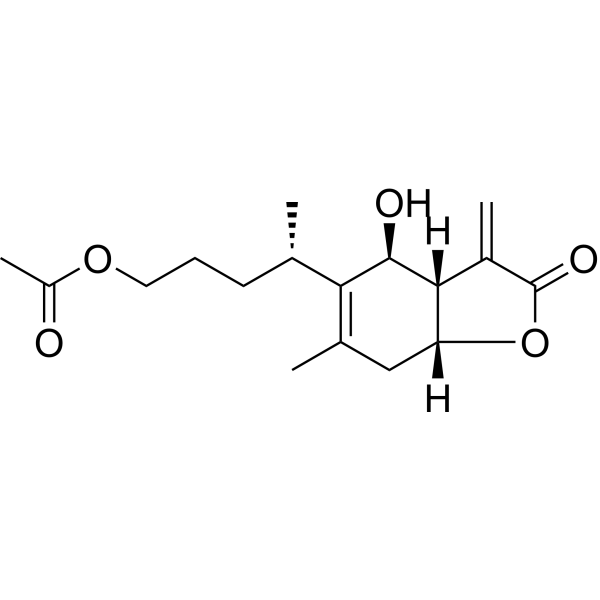
1-O-Acetyl britannilactone
CAS No. 681457-46-5
1-O-Acetyl britannilactone( —— )
Catalog No. M31103 CAS No. 681457-46-5
1-O-Acetyl britannilactone shows antifungal, and anti-cancer activities, it suppresses angiogenesis and lung cancer cell growth possibly via regulating the VEGFR-Src-FAK signaling.
Purity : >98% (HPLC)
 COA
Datasheet
HNMR
HPLC
MSDS
Handing Instructions
| Size | Price / USD | Stock | Quantity |
| 50MG | Get Quote | In Stock |


|
| 100MG | Get Quote | In Stock |
|
| 200MG | Get Quote | In Stock |
|
| 500MG | Get Quote | In Stock |
|
| 1G | Get Quote | In Stock |
|
Biological Information
-
Product Name1-O-Acetyl britannilactone
-
NoteResearch use only, not for human use.
-
Brief Description1-O-Acetyl britannilactone shows antifungal, and anti-cancer activities, it suppresses angiogenesis and lung cancer cell growth possibly via regulating the VEGFR-Src-FAK signaling.
-
Description1-O-Acetyl britannilactone shows antifungal, and anti-cancer activities, it suppresses angiogenesis and lung cancer cell growth possibly via regulating the VEGFR-Src-FAK signaling.
-
In Vitro——
-
In Vivo——
-
Synonyms——
-
PathwayOthers
-
TargetOther Targets
-
Recptor——
-
Research Area——
-
Indication——
Chemical Information
-
CAS Number681457-46-5
-
Formula Weight266.34
-
Molecular FormulaC17H24O5
-
Purity>98% (HPLC)
-
Solubility——
-
SMILES——
-
Chemical Name——
Shipping & Storage Information
-
Storage(-20℃)
-
ShippingWith Ice Pack
-
Stability≥ 2 years
Reference
molnova catalog



related products
-
Orexin A (human, rat...
Endogenous agonist at orexin receptors (Ki values are 20 and 38 nM for OX1 and OX2 receptors respectively). Stimulates feeding following central administration and may be involved in the control of sleep-wake cycle and other hypothalamic functions.
-
3-Chloro-L-Tyrosine
3-Chlorotyrosine a specific marker of myeloperoxidase-catalyzed oxidation is markedly elevated in low-density lipoprotein isolated from human atherosclerotic intima. In particular myeloperoxidase halogenates tyrosine residues in plasma proteins and generates 3-chlorotyrosine (CY).
-
yuanhuadine
Yuanhuadin, extracted from Genkwa Flos Daphne genkwa, has antitumor activity through inhibiting Akt/mTOR and EGFR pathways, induce cell-cycle arrest and abortion.
